Buyer preparation guide
How to Specify an Industrial Enclosure Hardware RFQ
Use this industrial enclosure hardware RFQ checklist and copyable RFQ template to show suppliers the interface, the required function and which acceptance criteria are essential rather than preferences.
Direct answer
What Should an Industrial Enclosure-Hardware RFQ Include?
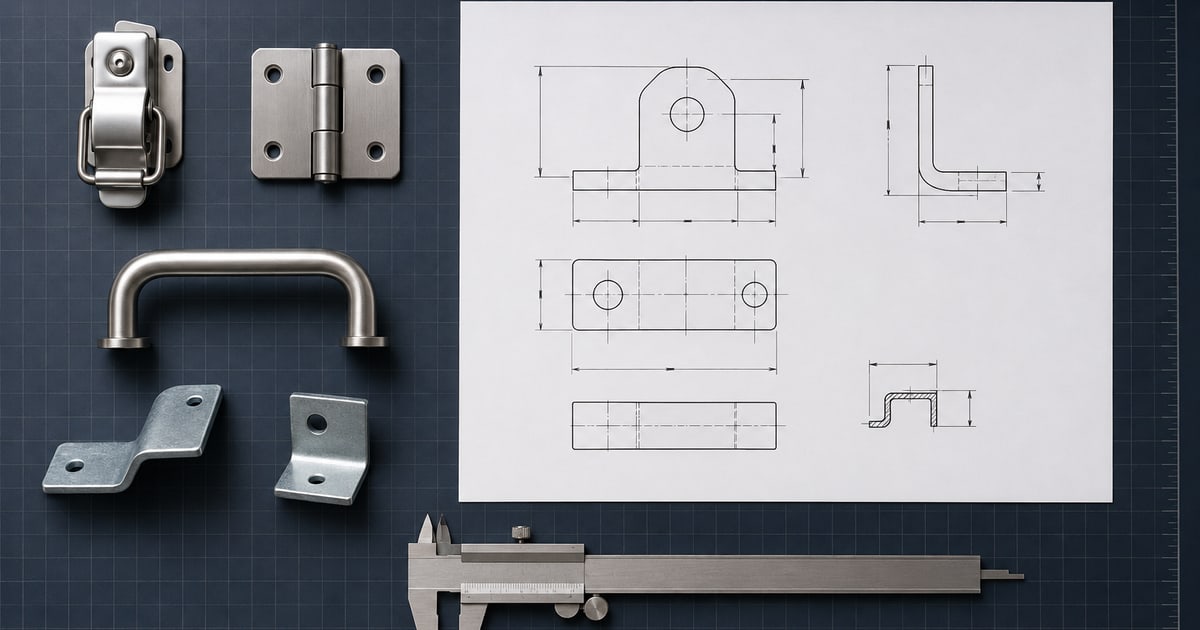
A useful enclosure-hardware RFQ should identify the part and drawing revision, explain the application and installed interface, define geometry, material and finish, state measurable performance and required evidence, and include prototype quantity, order quantity, annual volume, destination, timing, Incoterm and packaging expectations. Unknown details should be labeled as open instead of guessed.
- Identify the component function, installed interface and controlling drawing revision.
- Separate material, finish, measurable performance and required evidence.
- State prototype, order and annual volume plus destination, timing and delivery basis.
TW RFQ authors this preparation checklist. ASME supports the drawing-dimension and tolerance basis, while ICC supports the delivery-term basis; neither source publishes or endorses the complete checklist.
- ASME Y14.5-2018 (R2024) — Dimensioning and Tolerancing — American Society of Mechanical Engineers
- Incoterms® 2020 rules — International Chamber of Commerce
Four-part briefing process
Build the RFQ Around the Decision
Give suppliers enough context to identify fit, open questions and the right manufacturing route before they quote.
1. Define the function
State what the component must do: close a gasketed door, restrict access, position a panel, provide a pulling grip or support another enclosure component.
2. Show the complete interface
Include the mating door, frame, panel, keeper, cutout or mounting area. A component outline by itself often omits the dimensions that control fit.
3. Identify critical requirements
Mark dimensions, loads, clearances, finish, environmental exposure and tests that are acceptance criteria. Keep optional preferences visibly separate.
4. Add commercial context
Provide prototype and production quantities, annual demand, destination, required timing, packaging and any sample or inspection expectations.
Core specification
Information Every Useful RFQ Should Address
If a detail is unknown, describe the application instead of guessing a material, rating or standard.
| Area | What to provide |
|---|---|
| Part identification | Product family, project name, drawing number and revision, plus any reference part used only as a comparison point. |
| Application | Enclosure type, component function, operating frequency and the surrounding mechanism or load path. |
| Geometry | Dimensioned interface, panel thickness, cutouts, holes, offsets, gaps, available clearance and relevant datums. |
| Material and finish | Base material grade or compound and a separate coating, plating, passivation, paint or texture requirement. |
| Performance | Required load, torque, compression, cycle or environmental behavior with direction, units and an acceptance method. |
| Compliance evidence | Exact standard, revision, scope, document type and conditions of use rather than a general request for certification. |
| Commercial details | Prototype quantity, order quantity, annual volume, destination, target timing, Incoterm and packaging expectations. |
Illustrative example
Copyable RFQ Briefing Template
Replace every example value with the controlled requirement for your project. This is a preparation template, not a fictional customer case or supplier commitment.
Useful attachments
Files That Reduce Clarification Loops
Only upload files you are authorized to share. You can request an NDA before supplier review.
- 2D drawing with units, revision and critical tolerances
- 3D CAD model when useful for complex geometry
- Photos of the existing part and its installed interface
- Relevant specification or controlled standard excerpt you are authorized to share
- Expected quantities and delivery destination
- Inspection, sample, documentation and packaging requirements
Avoidable delays
Four Common RFQ Gaps
These gaps do not make an inquiry invalid, but they usually create another clarification round before meaningful evaluation.
Only a product photo
Photos help identify the family but rarely define cutouts, grip, offsets, clearances, load direction or exact material and finish.
A rating without installed conditions
An enclosure target such as IP or NEMA Type must be connected to the completed assembly, mounting method, seal and required evidence.
Material and finish combined
Write the base material and surface treatment separately so suppliers can evaluate the requested construction accurately.
No volume or project stage
Prototype, initial order and annual demand affect process and tooling decisions. State each separately when known.
Category-specific details
Add the Right Interface for Each Hardware Family
Open the matching category guide before submitting your request.
Enclosure Latches & Locks: detailed guides
Enclosure Hinges: detailed guides
Enclosure Handles & Pulls: detailed guides
Control Knobs & Handwheels: detailed guides
Metal Stampings & Formed Parts: detailed guides
Reference basis
Sources for Drawing, Delivery and Evidence Terminology
This checklist supports RFQ preparation. The cited standards, official rules, buyer specifications and supplier-controlled documents govern their own scope.
- ASME Y14.5-2018 (R2024) — Dimensioning and TolerancingAmerican Society of Mechanical Engineers
Official description of a widely used standard for communicating dimensions and tolerances on engineering drawings.
- Incoterms® 2020 rulesInternational Chamber of Commerce
Official overview of the ICC rules used to allocate delivery obligations, costs and risks in sales contracts.