Multipoint door locking

Swing Handle Locks and Multipoint Rod Locking for Cabinet Doors

Swing handle locks turn a cam or rod control behind a cabinet door; with multipoint rods, sometimes called an espagnolette, one turn also locks the door near its top and bottom. Fit depends on door height, point positions, handing and the closed frame section, so specify the handle, rods, catches and door together.

By ·

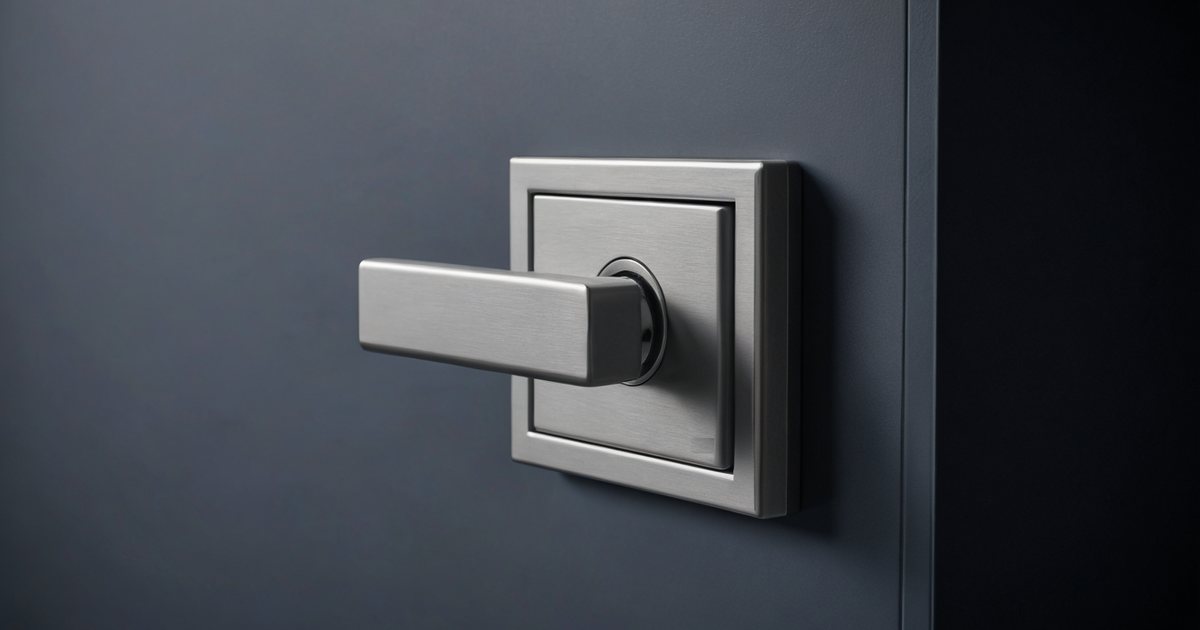
Generic flush swing handle with its lever in a recessed square housing on a dark gray cabinet door
Editorial illustration of a flush swing handle on a cabinet door. It is not a supplier model or statement of availability.

Direct answer

What is a swing handle lock, and when does a cabinet door need multipoint rod locking?

A swing handle lock is a flush cabinet handle that is swung to turn a cam or rod control on the inside of the door. In a multipoint system the rod control slides rods up and down, so the door also locks near its top and bottom. Choose it when door height and gasket resistance call for more than one locking point.

  • Set the number and positions of locking points from door height and gasket resistance.
  • Dimension rods, stroke, guides and the engagement at every point as one system.
  • Tie any IP or Type claim to the complete door, not to the handle listing.

Evidence at a glance

Swing Handle Ratings, Fit and Test Claims to Check

What does a swing handle’s IP 65 listing actually cover?

The listing is the maker’s statement for that handle, not a rating for your cabinet. EMKA lists protection class IP 65 for its 1125-U184-A swing handle, while Rittal states IP 55 for a VX25 enclosure whose door has a 4-point latch locking rod, with side panels mounted.

Boundary: Neither page shows a handle listing transferring to a different door, gasket, cutout, point count or frame; each figure belongs to the maker’s stated product or configuration.

Buyer action: Name the rating the finished cabinet must meet and request evidence for the exact door, gasket, handle and rods; see why component evidence is not an enclosure rating.

Will a latch kit sized for my door height fit any cabinet that tall?

No. nVent Hoffman sells its 3-point latch kits by enclosure height, yet says they fit most standard one-door Type 12 enclosures and will not fit its disconnect, Concept or ProLine enclosures. Height is one fit input among several.

Boundary: The height bands and fit list describe nVent Hoffman’s own enclosures; they do not establish fit on another maker’s door flange, frame profile or hinge layout.

Buyer action: Send door height with the closed door-and-frame section, flange returns, hinge side and gasket position so candidates can place rod guides and catches.

Do GR-63-CORE or DIN EN 61373 claims for a rod latch cover my cabinet door?

Not by themselves. Dirak lists its 3-211 compression rod latch as seismic-proof according to GR-63-CORE, Issue 4, and vibration-proof according to DIN EN 61373, but those statements describe that latch, not a buyer’s door.

Boundary: The product page names the standards but does not show the test report, door size, rod length, point spacing or mounting that was tested.

Buyer action: If the cabinet must meet a shock, vibration or seismic requirement, name the standard and request the report, the tested configuration and a validation plan for the complete door.

Primary sources:

Option comparison

Swing handle with multipoint rods vs single-point compression latches: which should I specify?

Use a swing handle with multipoint rods when one turn must lock a tall door at several points above and below the handle. Use single-point compression latches when a few separately operated points can hold the door and each needs controlled pull-up. Either way, dimension the closed door-and-frame section at every point.

Swing handle with multipoint rods vs single-point compression latches: which should I specify?
Decision factorSwing handle with multipoint rodsSingle-point compression latches
OperationOne handle turn moves every locking point.Each latch is opened and closed on its own.
Closing actionRods slide into catches; compression rod latches also press each point in.Each latch engages, then draws the door in by its stroke.
Key RFQ inputsDoor height, point positions, rod section and stroke, guides, catches and handing.Grip, compression stroke, cutout and frame engagement at each latch.
Common mistakeOrdering rods without door height, hinge side and frame section.Spacing latches without checking the gasket between them.
Decision basis: TW RFQ comparison based on EMKA, Dirak and nVent Hoffman multipoint documentation. Point count, stroke, compression and fit remain specific to the candidate system and door.

Configurations to compare

Single-Point Cam Handle

Turns one cam behind the frame at the handle; confirm that one point closes the gasket along the whole door edge.

Three-Point Rod System

A rod control drives an upper and a lower rod, so the door locks near its top and bottom as well as at the handle.

Extended Multipoint Rods

Adds catches along tall doors; EMKA’s plastic system allows up to 16 points at 75 mm intervals on doors 800 to 2,200 mm high.

Compression Rod Latches

Lock, then add compression at each point; Dirak’s 3-211 locks after a 90° turn and presses its cam 4 mm against the clamping surface with a further 45°.

Padlock and Cylinder Handles

Accept a padlock, a profile half cylinder or both; choose the locking set separately from the rod layout and check key removal.

Selection factors

Door, Rod and Locking-Point Inputs for a Swing Handle Quote

Swing Handle Locks RFQ selection factors
FactorWhat to specify
Door size and stiffnessGive door height, width, material and thickness with flanges and stiffeners; a door that bows between points will not load the gasket evenly.
Locking pointsState number and positions; EMKA relates the count to door height and seal resistance, and its 1125-U184-A handle lists 1 to 4 points, more on request.
Rods and strokeTake rod section, length, holes and stroke from the candidate drawing; Dirak’s 3-211 takes Ø8 mm round or 3 × 14 mm flat rods with a 23 mm stroke.
Guides and rod endsShow guide spacing and fastening plus the roller, shoe or hook at each catch; nVent Hoffman kits set gasket compression by relocating pins in the rod guides.
Handle cutout and door thicknessWork from the candidate’s cutout drawing and door-thickness range, which is model-specific; EMKA lists 1.5 to 2 mm for its 1125-U184-A.
Handing and rotationState hinge side and opening rotation from a named viewing side; some systems reverse, while nVent Hoffman keylock kits come in clockwise and counterclockwise versions.
Lock insert and seal positionSpecify the padlock shackle or cylinder and keying, the handle seal, and whether handle and rods sit inside or outside the gasket line.

Installed interface

  1. 01

    Handle and lock insert

    Handle style, cutout, door thickness, handle seal, padlock or cylinder and opening rotation.

  2. 02

    Rod control

    Turns handle rotation into rod stroke; its stroke, cam and handing must match the rods.

  3. 03

    Rods and guides

    Round or flat section, length, hole positions, guide spacing and guide fastening.

  4. 04

    Rod ends and catches

    Rollers, shoes or hooks, closed engagement, catch position and adjustment.

  5. 05

    Door, gasket and frame

    Door stiffness, gasket line, point spacing, frame section and the completed-enclosure claim.

Practical answer

How do I specify a swing handle with multipoint rod locking?

Specify the handle, rod control, rods, guides, rod ends and frame catches as one system. Point count is not generic: EMKA relates it to door height and seal resistance, and nVent Hoffman sells 3-point kits in enclosure-height bands. Take rod section and stroke from the candidate drawing, give the handle cutout, hinge side, opening rotation and lock insert, mark the gasket line, and dimension closed engagement at every point as you would compression-latch grip.

  1. Send door height, width, thickness and material, with stiffeners and the closed frame section.
  2. Set the number and positions of locking points from door height and gasket resistance.
  3. Name rod section, length, stroke and guide spacing, plus the cam, roller, shoe or hook at each point.
  4. Mark the handle cutout, hinge side and opening rotation, drawn as in the unambiguous cam-direction sketch, plus the padlock or cylinder.
  5. Show the handle seal, gasket line and frame profile at each catch, then request the installation drawing.

Copy into your request

Swing Handle Locks RFQ template

Door height, width, thickness and material: [ ]
Number and positions of locking points: [ ]
Rod section, length, stroke and guide spacing: [ ]
Rod-end type and closed engagement at each catch: [ ]
Handle cutout drawing and door stiffeners: [ ]
Hinge side and opening rotation from a named side: [ ]
Padlock shackle size, cylinder type and keying: [ ]
Gasket line and required enclosure-rating evidence: [ ]
Prototype, order and annual quantities: [ ]

Application decision

Choosing Points, Rods and Handle Options by Door Condition

Choosing Points, Rods and Handle Options by Door Condition
Application conditionRFQ direction
One point can hold the doorCompare a single-cam swing handle with a compression latch and confirm the gasket closes along the full edge.
Tall door or firm gasketRequest a three-point or multipoint rod system and set point count from door height and seal resistance.
Gasket needs pull-up at every pointEvaluate compression rod latches and state the compression and stroke each point must provide.
Hinge side may changeAsk for a reversible or symmetrical layout and confirm which parts change with the opening rotation.
Shock, vibration or seismic dutyName the standard and ask whether its test covered the latch alone or a complete door with rods.

Applications to describe in the RFQ

01

Floor-Standing Control Cabinets

Give door height, single or bayed layout, hinge side, gasket line and the rating the finished cabinet must meet.

02

Outdoor Distribution Cabinets

Add weather and UV exposure, rod and handle materials, padlock or cylinder policy and water shedding around the handle.

03

Server and Network Racks

State keying or access control, opening frequency and the rod path past perforated doors and mounted equipment.

04

Rail and Vehicle Equipment Cabinets

Name the shock and vibration standard, door size and point count, and ask which configuration the latch test covered.

Buyer questions

Swing Handle Locks FAQ

Answers without a listed source are TW RFQ editorial guidance, not an external standard or part-specific approval.

Is an espagnolette the same as a multipoint rod lock?

Largely, yes. Espagnolette is a traditional door-and-window name for a handle-operated rod lock that secures the head and sill; enclosure makers more often say rod control, rod latch or 3-point latch kit. Names do not fix the mechanism, so show how the rods move and what each end engages.

Flat rods or round rods: which should I request?

Follow the candidate system rather than a general preference. EMKA says flat-rod systems are mainly installed in Europe and round-rod systems mostly in America and Asia. Dirak’s 3-211 accepts Ø8 mm round or 3 × 14 mm flat rods, and Dirak recommends round rods there for strength and stability.

Sources: EMKA, DIRAK
Should the handle and rods sit inside or outside the door seal?

Both layouts are sold. EMKA lists its 1125-U184-A handle for mounting inside or outside the sealing, while Dirak’s 3-211 rod latch is made for installation inside the door sealing. Mark the gasket line on the door section and ask which position the candidate’s rating evidence covers.

Sources: EMKA, DIRAK
What changes when a rod-locked door is moved to the other hinge side?

Possibly the handle rotation and the kit itself. EMKA’s plastic system and Rittal’s VX25 door allow the hinge side to be changed, while nVent Hoffman lists its keylock 3-point kits as separate clockwise- and counterclockwise-opening versions. State the new hinge side and opening rotation, and ask which parts must change.

Technical reference basis

Sources

What these buyer guides do not establish

Sources last checked: .

Private sourcing review

Have a drawing, photo or reference part?

Send the interface and commercial requirements for a focused Taiwan sourcing review.

Request a Quote