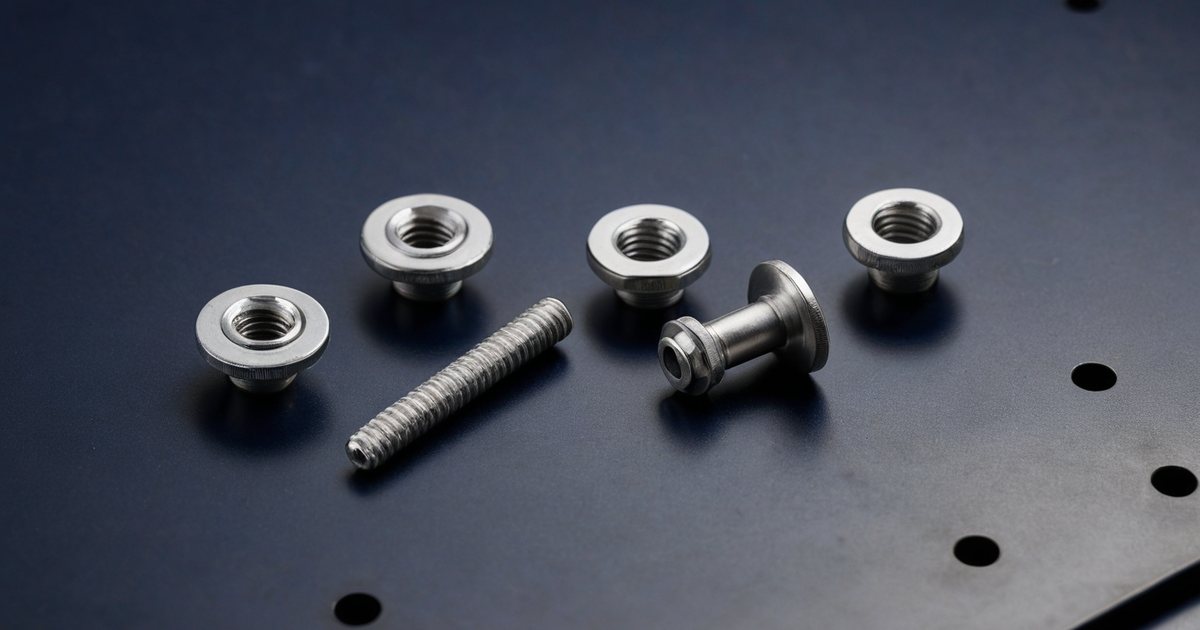
Removable access-panel fastening

Quarter-Turn Fasteners and Captive Screws for Access Panels

Quarter-turn fasteners and captive panel screws hold removable access panels and covers that must be opened again in service. A quarter-turn fastener’s stud turns into a receptacle on the frame, and its length follows the total material thickness; a captive panel screw stays in the panel when undone. Specify either one as an installed joint, not a loose part.

By ·

Generic panel-fastener parts: flanged threaded receptacles, a loose threaded stud and a captive screw on a perforated sheet-metal panel
Editorial illustration of panel-fastener components on a sheet-metal panel. It is not a supplier model or statement of availability.

Direct answer

What are quarter-turn fasteners and captive panel screws?

A quarter-turn fastener is a stud in a removable panel that turns into a matched receptacle on the frame; a retainer usually keeps the stud with the panel, and the stud length is chosen from the total material thickness using that receptacle’s formula. A captive panel screw is a threaded screw held in the panel by a retainer—commonly self-clinching, flare-mounted or floating—so it cannot fall out when undone.

  • Name the receptacle and retainer first; each changes the thickness formula.
  • Give panel, frame and compressed-gasket thicknesses as minimum and maximum values.
  • For captive screws, state thread, sheet material, hardness and installation type.

Evidence at a glance

Stud Length, Sheet Hardness and Pushout Claims to Verify

Will one stud length cover my panel-thickness tolerance?

Only if both the thinnest and the thickest stack fall inside the range of one stud length. Stud lengths come in fixed steps, and Southco lists how much thickness variation each of its quarter-turn lines tolerates; the values differ between lines.

Boundary: The thickness calculation also changes with the receptacle and the maker: Southco adds gasket, retainer or clip allowances, while Howmet’s catalog gives separate stud-length tables for flush and plus-flush grommets, with a column for each receptacle type.

Buyer action: State minimum and maximum panel, frame and compressed-gasket thicknesses, and ask the supplier to confirm that one stud length covers both extremes or to propose two lengths.

Can a self-clinching captive screw be pressed into stainless-steel sheet?

Only a type made harder than the sheet. PennEngineering notes that 300-series stainless fasteners do not meet that rule in stainless panels, so it offers a 400-series type, which it says should not be used where the product sees appreciable corrosion, needs non-magnetic fasteners or runs above 300 °F (149 °C).

Boundary: Each self-clinching model lists its own maximum sheet hardness, and one Southco self-clinching quarter-turn receptacle is limited to annealed sheet at or below a stated hardness.

Buyer action: State the sheet grade, temper or hardness and thickness; if the sheet is too hard, ask for a flare-mounted screw or another attachment, and settle stainless grade and corrosion requirements separately.

Primary sources:

What does a captive-screw pushout figure actually show?

It is an average retention value measured in a named test sheet, such as aluminum or cold-rolled steel, after correct installation. It does not describe clamp load, vibration resistance or cycle life, and PennEngineering recommends testing the fastener in the application.

Boundary: PennEngineering states that hole size, sheet material and installation procedure may affect performance, and Howmet publishes lower tensile and working loads for its stainless quarter-turn studs than for its zinc-plated steel ones.

Buyer action: State panel material, thickness and hole process, ask for data from the closest test sheet, and plan a pushout check on production panels during first-article inspection.

Primary sources:

Option comparison

Quarter-turn latch vs quarter-turn fastener: what is the difference?

A quarter-turn cam latch is installed in a hinged door: turning its insert swings a cam at least 90 degrees behind the frame. A quarter-turn fastener is a joint: a stud, usually retained in a removable panel, turns into a matched receptacle fixed to the frame, so the frame part must be specified too and stud length follows total material thickness.

Quarter-turn latch vs quarter-turn fastener: what is the difference?
Decision factorQuarter-turn cam latchQuarter-turn fastener
Typical closureHinged door, latched on the edge opposite the hinges.Removable panel or cover fastened to a frame.
Frame sideThe cam turns behind the frame edge.A matched receptacle is riveted, welded, clipped or pressed on.
Sizing inputClosed grip, cam length and offset, rotation.Total material thickness from the receptacle’s formula.
Common RFQ gapGiving panel thickness instead of closed grip.Ordering studs without naming receptacle and retainer.
Decision basis: TW RFQ comparison drawn from EMKA’s quarter-turn latch description and Southco quarter-turn fastener literature. Exact engagement, load and thickness ranges remain model-specific.

Configurations to compare

Stud and Frame Receptacle

A cam or spiral stud in the panel turns into a receptacle matched to its product line; the receptacle sets the thickness formula.

Retainer, Ring or Grommet

Holds the stud in the open panel; each type has a listed thickness allowance and may need a dedicated installation tool.

Floating Receptacle or Screw

Accepts limited misalignment between panel and frame holes; the float allowance comes from the exact part drawing.

Self-Clinching Captive Screw

Pressed into a properly sized hole to sit flush on the back of the panel, within the model’s sheet-hardness and thickness limits.

Flare-Mounted Captive Screw

Its retainer is flared into a countersunk hole with lower installation force, which suits hard, thin or painted panels.

Selection factors

Sizing a Stud or Captive Screw: Thickness, Receptacle and Installation

Quarter-Turn & Captive Panel Fasteners RFQ selection factors
FactorWhat to specify
Total material thicknessGive panel, frame and compressed-gasket thicknesses as minimum and maximum values; the supplier adds retainer or clip allowances from the receptacle’s formula.
Receptacle attachmentName rivet-on, weld-on, clip-on, snap-in, press-in or self-clinching mounting, the frame thickness and material, and whether the back of the frame can be reached.
Stud retentionState whether the stud must stay in the open panel and which retainer, ring or grommet is acceptable, together with its installation tool.
Head style and driveChoose wing, bail or knob heads for hand operation, or slotted, Phillips, hex or security drives where opening must require a tool.
Captive-screw typeSpecify thread, screw length, self-clinching, flare-mounted or floating installation, spring-loaded or non-spring design and any anti-cross-threading feature.
Sheet and holeState sheet material, hardness and thickness; take hole size, countersink and minimum edge distance from the candidate drawing and follow its hole-preparation rules, such as no deburring.
Load, access and exposureDescribe tensile load direction, vibration or impact, access frequency, cycle target, temperature and corrosion exposure.

Installed interface

  1. 01

    Head and drive

    Head style, drive, projection above the panel and hand or tool access.

  2. 02

    Panel and retention

    Panel hole, countersink, retainer or grommet, sheet hardness and thickness.

  3. 03

    Material stack

    Panel, gasket and frame thicknesses that set total material thickness or screw length.

  4. 04

    Frame side

    Receptacle type and attachment, or the threaded hole or nut the captive screw engages.

  5. 05

    Installed joint

    Hole alignment, tensile load, vibration, access cycles and installation tooling.

Practical answer

How should I specify a quarter-turn fastener or captive panel screw in an RFQ?

Describe the installed joint and let the supplier choose parts from its selection chart. For a quarter-turn fastener, name the receptacle and its frame attachment, name the retainer, and give panel, frame and compressed-gasket thicknesses so total material thickness, and then stud length, can be calculated. For a captive panel screw, give thread, sheet material, hardness, thickness and installation type. For both, add head style, hole sizes from the candidate drawing and who supplies the installation tooling. If the part closes a hinged door, specify a quarter-turn cam latch instead.

  1. Draw one section through panel, gasket and frame with minimum and maximum thicknesses.
  2. Name the receptacle mounting—rivet, weld, clip, snap-in, press-in or self-clinching—and whether the frame back is reachable.
  3. Name the retainer or grommet, then have the supplier confirm total material thickness and stud length.
  4. For captive screws, state thread, screw length, sheet hardness and self-clinching, flare-mounted or floating installation.
  5. Take hole sizes, edge distances, head style and installation tooling from the approved candidate drawing.

Copy into your request

Quarter-Turn & Captive Panel Fasteners RFQ template

Panel, frame and gasket thickness range: [ ]
Receptacle type and frame attachment: [ ]
Retainer, ring or grommet requirement: [ ]
Stud head style and drive: [ ]
Captive-screw thread, length and installation type: [ ]
Sheet material, hardness and hole details: [ ]
Tensile load, vibration and access cycles: [ ]
Installation responsibility and tooling: [ ]
Sample, first-order and annual quantities: [ ]

Application decision

Door, Panel or Cover: Choosing a Fastener by How It Is Opened

Door, Panel or Cover: Choosing a Fastener by How It Is Opened
Application conditionRFQ direction
Hinged door latched on one edgeSpecify a quarter-turn cam latch by grip and cam geometry rather than a stud-and-receptacle fastener.
Removable panel opened by handCompare wing, bail or knob heads and spring-loaded captive screws; state access frequency and glove use.
Access limited to trained staffChoose slotted, hex, security or tool-only heads and name the tool the service team carries.
Holes that may not line upAsk for a floating receptacle or floating captive screw and state the hole-position tolerance.
Hard, stainless or painted panelCheck the self-clinching hardness limit, or use a flare-mounted screw or a riveted receptacle instead.

Applications to describe in the RFQ

01

Machine Access Panels

State vibration from running motors, how often the panel is opened, glove use and whether opening must require a tool.

02

Electronics Chassis Covers

Give thin-sheet thickness and hardness, flush or low-profile head needs and why loose hardware inside the unit is unacceptable.

03

Transport and Mobile Equipment

Describe motion and impact exposure, panel alignment and retained studs that must not drop out in service.

04

HVAC and Filter Access Covers

State cover size, gasket compression, access interval and whether panels are painted before the fasteners go in.

Buyer questions

Quarter-Turn & Captive Panel Fasteners FAQ

Answers without a listed source are TW RFQ editorial guidance, not an external standard or part-specific approval.

Is a Dzus fastener the same as a quarter-turn fastener?

DZUS is a registered trademark of Southco for its quick-access fastener lines, so the name identifies one maker’s product family rather than a generic part. In an RFQ, write “quarter-turn fastener” and list the stud, receptacle and total material thickness; quote a Southco part number only when you need that exact part, and use the equivalent-part evaluation guide for alternatives.

Sources: Southco
Self-clinching, flare-mounted or floating captive screw: which should I specify?

Self-clinching types are pressed into a hole and sit flush on the back of the panel, but only within the model’s sheet-hardness limit. Flare-mounted types go into a countersunk hole with less installation force, install into any panel hardness and suit painted panels. Floating types, which are also flare-mounted, compensate for misaligned mating holes. Choose by panel hardness, finishing sequence and hole-position tolerance.

What does the retainer or grommet on a quarter-turn stud do?

It holds the stud in the panel so the stud stays with the panel when the fastener is open. It also changes the stack: Southco adds a retainer adjustment value to total material thickness, and Howmet’s catalog gives separate stud-length tables for flush and plus-flush grommets. Name the retainer and its installation tool before the stud length is fixed.

Can a quarter-turn fastener hold a panel against a gasket?

It can when the compressed gasket thickness is counted in total material thickness, as Southco’s formulas do, and when the chosen fastener line suits the clamping load. The joint does not establish an enclosure rating by itself; see IP and NEMA evidence for installed hardware.

Sources: Southco, Southco

Technical reference basis

Sources

What these buyer guides do not establish

Sources last checked: .

  • Quick Access Fasteners brochureSouthco

    Manufacturer overview of the quarter-turn system (stud, retainer and receptacle), receptacle and stud styles, design questions and qualitative ratings it says should be confirmed by application testing.

  • PF PEM captive panel screws bulletinPennEngineering

    Manufacturer bulletin on self-clinching, flare-mounted and floating captive panel screws, sheet-hardness limits, hole preparation, installation tooling and test-sheet performance data.

  • D4 DZUS Standard Line quarter-turn fastenersSouthco

    Manufacturer literature showing receptacle-specific total material thickness formulas, stud-length tables, retainers and retainer installation tools.

  • D8 DZUS PANEX quarter-turn fastenersSouthco

    Manufacturer literature illustrating rivet-on, weld-on, clip-on, side-mount, press-in and self-clinching receptacles and their thickness allowances.

  • Camloc D4002 series quick-release fastenersHowmet Aerospace

    Manufacturer catalog that selects stud length from total thickness in separate tables by grommet and receptacle type, with floating receptacles and material-specific load ratings.

  • Quarter turns for industrial cabinetsEMKA

    Manufacturer page describing how a quarter-turn latch cam turns behind the door frame; used only for the latch side of the comparison.

Private sourcing review

Have a drawing, photo or reference part?

Send the interface and commercial requirements for a focused Taiwan sourcing review.

Request a Quote