Tool-free threaded clamping

Clamping and Star Knobs for Industrial Adjustment

A star knob or clamping knob turns a threaded joint by hand; its lobes help the operator but do not define clamp force or tightening torque. Specify the thread interface (female thread or male stud), the contact condition and the real joint before comparing knob geometry.

By · ·

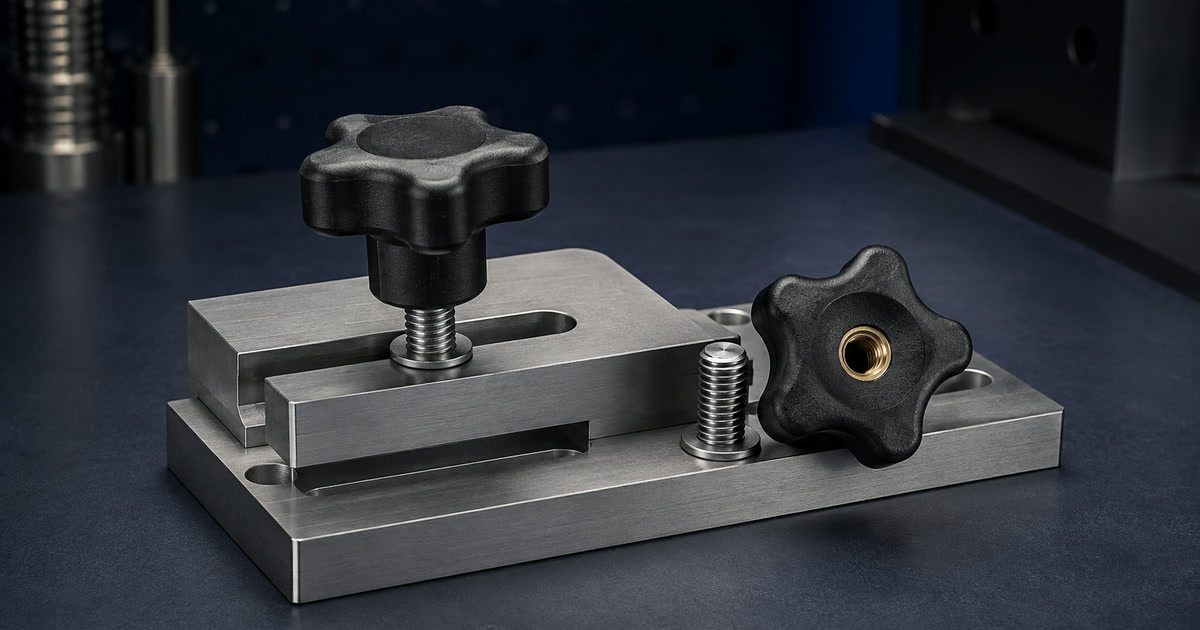
Generic black star knobs with threaded stud, female insert and swivel thrust-pad configurations on a machine fixture
Editorial illustration of clamping-knob interfaces; not a torque rating or supplier catalog offer.

Direct answer

How should a clamping or star knob be selected?

Choose a clamping or star knob from the required thread interface, engagement length, target clamp force, available hand clearance, contact geometry, environment and adjustment frequency. An ordinary hand knob does not provide controlled tightening torque; when repeatability or damage prevention matters, specify a verified torque-limiting mechanism and test the real joint.

  • State complete metric or inch thread and usable engagement.
  • Define clamp function and contact geometry instead of inferring force from knob size.
  • Use a purpose-designed torque limiter when a repeatable release setting is required.

Evidence at a glance

Star Knob Questions About Clamp Force, Thread Load and Torque Limits

Can clamp force be inferred from knob diameter?

No. Hand-applied torque varies with operator, gloves, contamination, posture and grip, while joint friction and thread geometry change the resulting clamp force.

Boundary: A knob dimension or ergonomic form is not a calibrated torque input or assembly clamp-force measurement.

Buyer action: Define the required joint result and validate it directly, or specify a verified torque-limiting mechanism where appropriate.

Does a polymer knob body define allowable thread load?

No. Insert anchorage and body strength depend on exact design, temperature, load direction, engagement, cycling and whether the joint applies an unapproved withdrawal moment.

Boundary: Generic material names and visual similarity do not establish insert pull-out, torque or fatigue capability.

Buyer action: Request exact-part load limits and validate the real thread, contact and environmental condition.

Primary sources:

Is every hand knob a torque limiter or captive guard fastener?

No. Hand operation alone does not provide a repeatable torque release, captive retention, interlocking or a machine-safety function for the complete guarded assembly.

Boundary: Those are separate mechanisms and system requirements that must be intentionally specified and verified.

Buyer action: Name torque limiting, captivation or safety access as separate requirements and route each to the responsible design review.
Primary sources:

Option comparison

Star knob with female thread or male stud: which should I choose?

A male-stud knob combines the hand element and screw; a female-insert knob accepts a separate stud or bolt. Choose from assembly direction, replacement, available engagement and whether exposed thread must be controlled.

Star knob with female thread or male stud: which should I choose?
Decision factorMale studFemale insert
Mating partNeeds a female thread.Needs a male stud or screw.
Length controlStud projection belongs to the knob.Separate fastener controls projection.
ReplacementKnob and stud replace together.Knob and stud may be serviced separately.
Primary riskWrong stud length or tip.Bottoming or insufficient insert engagement.
Decision basis: TW RFQ comparison based on cited clamping-knob interface material. Exact insert depth, stud grade and allowable loads remain candidate-specific.

Configurations to compare

Blind Female Insert

Accepts a male thread to a controlled depth and needs bottoming clearance plus adequate engagement.

Through Female Insert

Allows variable screw projection while adding exposed-thread and contamination considerations.

Fixed Male Stud

Combines knob and screw when stud length, tip form and mating-thread access are controlled.

Movable Thrust Pad

Accommodates slight nonparallel contact and reduces marking within its exact load and articulation limits.

Torque-Limiting Knob

Releases or slips at a stated setting only when the exact mechanism, direction, tolerance and joint are validated.

Selection factors

Thread, Engagement and Clamp Inputs for a Star Knob Quote

Clamping & Star Knobs RFQ selection factors
FactorWhat to specify
Thread specificationState metric or inch system, diameter, pitch, fit, handedness and mating-thread material.
Engagement and tipDefine female depth or stud length, usable engagement, end form, bottoming clearance and tolerance.
Clamp requirementState target force, load direction, friction assumptions and whether a controlled torque limit is required.
Hand interfaceSpecify knob diameter, lobe count or shape, glove use, available sweep and acceptable hand effort.
Contact geometryDescribe the clamped surface, angular misalignment, marking limits and need for a swivel pad.
Material and environmentList body and insert materials, temperature, chemicals, UV, corrosion, hygiene and cleaning.
Duty and retentionProvide cycles, vibration, captive or loss-protection needs, tamper control and validation method.

Installed interface

  1. 01

    Operator grip

    Diameter, lobe form, gloves, effort, clearance and frequency.

  2. 02

    Knob body and insert

    Materials, insert anchorage, temperature and chemical exposure.

  3. 03

    Thread interface

    Designation, engagement, fit, bottoming, stud length and tip.

  4. 04

    Contact surface

    Load direction, pad, alignment, marking and friction.

  5. 05

    Complete joint

    Clamp result, cycles, vibration, retention and validation method.

Practical answer

How should thread engagement be written in a knob RFQ?

State the complete thread designation, mating material, available depth and minimum usable engagement after allowing for chamfers, blind-hole bottom clearance and any washer or panel stack. For a stud knob, define projection from the seating face and tip form. For a female insert, define usable thread depth rather than only the knob’s outside dimensions.

  1. Write metric or inch designation in full.
  2. Identify mating thread material and condition.
  3. Separate available depth from usable engagement.
  4. Control stud projection or insert bottom clearance.
  5. Verify strength and cycles in the real joint.

Copy into your request

Clamping & Star Knobs RFQ template

Metric or inch thread, diameter, pitch and fit: [ ]
Female insert depth or male stud length: [ ]
Tip or movable-pad geometry: [ ]
Mating-thread material and usable engagement: [ ]
Target clamp force and load direction: [ ]
Torque limit or ordinary hand-tightening expectation: [ ]
Knob diameter, grip shape, gloves and sweep clearance: [ ]
Cycles, vibration and captive/loss prevention: [ ]
Body/insert material and service environment: [ ]

Application decision

Star Knob Options by Thread Interface, Contact and Over-Tightening Risk

Star Knob Options by Thread Interface, Contact and Over-Tightening Risk
Application conditionRFQ direction
Knob screws into the machineUse a male-stud review with projection, tip and mating engagement controlled.
Knob turns on an existing studUse a female-insert review with depth, bottoming and exposed-thread requirements.
Nonparallel contactConsider a movable pad with articulation, surface marking and exact load verified.
Over-tightening riskSpecify an actual torque-limiting mechanism, setting tolerance and joint validation.
Guard or retained panelTreat captivation and machine-safety access as separate system requirements.

Applications to describe in the RFQ

01

Workholding and Inspection Fixtures

Define contact, repeatability, operator force and whether the knob positions or clamps the workpiece.

02

Adjustable Stops and Guides

Control thread, travel, tip form, vibration and the locked position.

03

Removable Panels

Keep knob convenience separate from captive-fastener and machine-guard safety requirements.

04

Laboratory and Packaging Equipment

Add cleaning, chemicals, fine adjustment, gloves and over-tightening risk.

Buyer questions

Clamping & Star Knobs FAQ

Answers without a listed source are TW RFQ editorial guidance, not an external standard or part-specific approval.

Star knob or rounded lobe knob?

Compare grip force, clearance, snag risk, cleaning and frequency; neither shape establishes clamp capacity.

Can a star knob be sized for gloved hands?

Yes, if the RFQ gives the glove type, the hand effort the operator can apply and the available sweep, so the supplier can propose a knob diameter and lobe shape to suit. The lobe shape affects grip, not clamp capacity.

When is a torque-limiting knob justified?

Use one when over-tightening can damage a part or when a verified repeatable release setting is required.

When is a movable thrust pad useful?

It can accommodate slight nonparallel contact and reduce marking, within the exact candidate’s load and angle limits.

Technical reference basis

Sources

What these buyer guides do not establish

Sources last checked: .

Private sourcing review

Have a drawing, photo or reference part?

Send the interface and commercial requirements for a focused Taiwan sourcing review.

Request a Quote