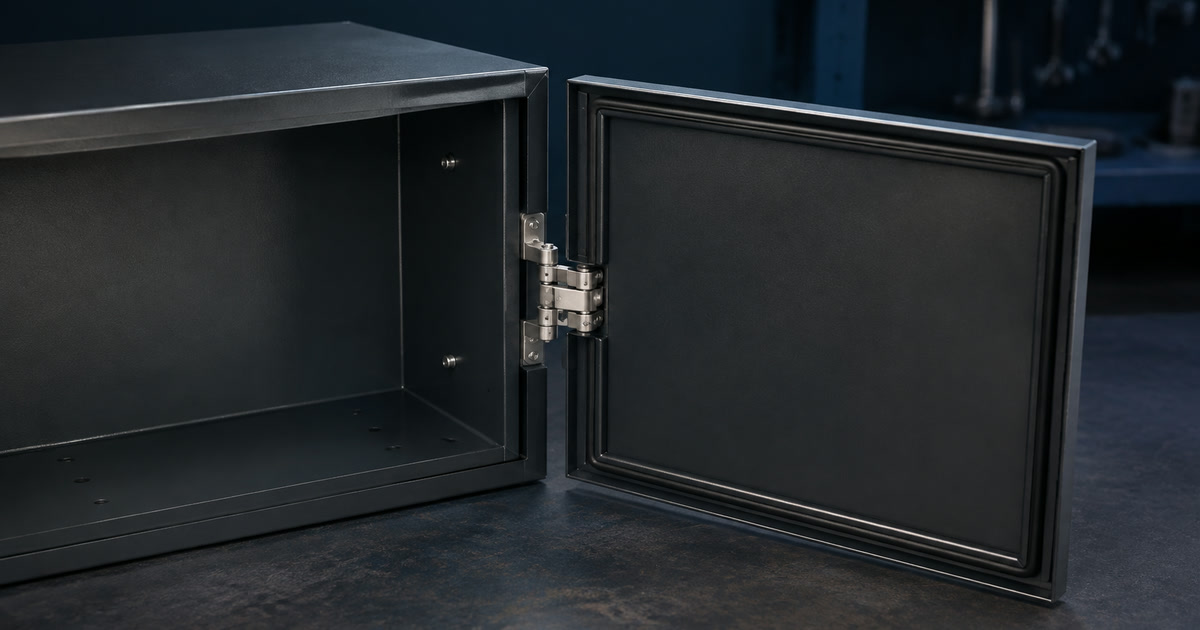
Hidden industrial door motion

Concealed Hinges for Industrial Enclosure Doors

A concealed enclosure hinge keeps the hardware behind a closed door, but it still needs a complete door-return section, usable opening angle, internal envelope and installed load case.

By · ·

Generic concealed hinge mounted behind an open sheet-metal enclosure door with pivot path visible
Editorial illustration of concealed-hinge installation geometry; not a furniture hinge or supplier model.

Direct answer

What is a concealed enclosure hinge, and what does hidden mounting change?

A concealed enclosure hinge mounts behind the closure so it is not visible when the door is shut. It can improve exterior appearance and reduce exposed hardware, but concealed placement alone does not guarantee removability, sealing, hold-open behaviour, load capacity or forced-entry resistance. The installed pivot path and internal clearances control suitability.

  • Submit the complete flush, inset, overlay or prominent-door section.
  • Define minimum usable opening angle and every nearby interference.
  • Calculate the door load case from mass, centre of gravity and hinge layout.
Sources for this answer:

Evidence at a glance

Concealed Hinge Claims About Opening Angle, Count and Security

Does a catalog opening angle equal the installed opening angle?

Not necessarily. Door returns, gaskets, adjacent panels, handles and the enclosure wall can reduce the usable opening below a nominal catalog value.

Boundary: The exact hinge drawing defines its motion, while the buyer’s assembly defines surrounding interference.

Buyer action: Model the candidate in the enclosure and state the minimum clear installed angle as the acceptance condition.

Primary sources:

Can hinge count be selected by dividing door weight by one rating?

No. Centre-of-gravity moment, spacing, orientation, mounting substrate, shock, alignment and fatigue can govern the installed door even when simple division by a catalog value appears acceptable.

Boundary: A model-specific load statement is not a completed-door calculation or dynamic validation.

Buyer action: Provide the full door load case and require the candidate arrangement, fasteners and panels to be reviewed together.

Primary sources:

Does hidden hardware establish security or weatherproofing?

No. Concealed mounting may reduce exterior exposure, but it does not by itself establish forced-entry resistance, sealing or an enclosure rating.

Boundary: Those claims depend on the complete door, frame, latch, gasket, mounting and applicable test evidence.

Buyer action: Name each required claim separately and request evidence for the exact installed configuration.

Primary sources:

Option comparison

Concealed 90-degree vs 180-degree hinge: what should a buyer compare?

Compare the required usable service opening, pivot path, internal package space and door-clearance envelope. A larger nominal angle may require more complex linkage or internal space and still can be limited by the enclosure assembly.

Concealed 90-degree vs 180-degree hinge: what should a buyer compare?
Decision factorLimited-angle concealedWide-angle concealed
Service accessSuitable where a smaller clear opening is acceptable.Targets wider access or movement clear of the side panel.
Motion pathUsually simpler but still section-dependent.May use additional offset or linkage and swept volume.
PackagingCheck local internal clearance.Check larger internal and external interference envelope.
AcceptanceVerify minimum installed angle.Verify angle plus full collision-free path.
Decision basis: TW RFQ comparison based on cited manufacturer hinge examples. Exact motion, load and clearance depend on the candidate drawing and installed geometry.

Configurations to compare

Fixed-Pin 90-Degree

A compact hidden pivot for a limited opening where the door return clears the frame.

120- or 125-Degree Roller

Extends service access but still requires installed interference and seal-line checks.

180-Degree Multi-Link

Uses a more complex path and internal envelope to move the door clear of the enclosure side.

Concealed Door-Stay

Adds position control or hold-open behaviour that must be defined separately from hinge load.

Concealed Counterbalance

Assists a lid or heavy panel only when torque, centre of gravity, travel and exact mechanism data are matched.

Selection factors

Door Section, Pivot and Opening-Angle Inputs for a Concealed Hinge Quote

Concealed Enclosure Hinges RFQ selection factors
FactorWhat to specify
Door constructionIdentify flush, inset, overlay or prominent construction and provide the full door return, frame and seal section.
Pivot and envelopeDimension hinge offset, closed position, internal package space and the swept volume through opening.
Usable opening angleState the minimum installed angle and model adjacent doors, handles, walls, gasket and frame interference.
Door load caseProvide mass, dimensions, centre of gravity, orientation, hinge spacing, shock and desired cycles.
MountingControl weld, stud, screw, rivet, clip or tool-less attachment plus panel thickness and reinforcement.
Handing and functionsState right, left or reversible handing and any removal, hold-open or counterbalance requirement.
EnvironmentDescribe material, finish, corrosion, temperature, vibration, washdown and lubrication constraints.

Installed interface

  1. 01

    Door edge and return

    Construction, thickness, stiffness, edge clearance and moving surface.

  2. 02

    Pivot mechanism

    Axis or linkage, offset, opening path, stops and lubrication.

  3. 03

    Frame and seal line

    Return geometry, gasket clearance and closed alignment.

  4. 04

    Mounting structure

    Fasteners or welds, panel reinforcement, access and tolerance.

  5. 05

    Complete door load

    Mass, centre of gravity, spacing, shock, cycles and restraint.

Practical answer

What enclosure section should I send for a concealed-hinge RFQ?

Send a section through the door edge, door return, gasket or seal line, frame return and proposed hinge region in both closed and required-open positions. Identify the enclosure inside, nearby equipment, fastener or weld access and no-go volumes. Add door mass, centre of gravity and hinge spacing so geometry and load are reviewed together.

  1. Draw the closed door and frame section.
  2. Add door return, gasket and seal line.
  3. Mark pivot candidates and internal no-go space.
  4. Show the minimum required open position and swept envelope.
  5. Attach the full door load and mounting data.
Reference basis:

Copy into your request

Concealed Enclosure Hinges RFQ template

Full door/frame/return/gasket section: [ ]
Flush, inset, overlay or prominent construction: [ ]
Pivot offset and closed hinge location: [ ]
Minimum usable opening angle and swept envelope: [ ]
Door mass, centre of gravity and hinge spacing: [ ]
Mounting method, panel thickness and reinforcement: [ ]
Handing, removal and hold-open requirements: [ ]
Shock, vibration, cycles and environment: [ ]
Exact-part load and installation evidence: [ ]

Application decision

When a Concealed Hinge Fits the Door, and When It Does Not

When a Concealed Hinge Fits the Door, and When It Does Not
Application conditionRFQ direction
Clean exteriorUse concealed mounting only after internal space and assembly access are confirmed.
Wide service accessCompare actual pivot paths and installed interference, not only nominal angle.
Removable service doorRoute to a lift-off or captive-pin review when removal is the primary need.
Heavy lid assistanceTreat counterbalance torque, centre of gravity and travel as a separate engineered function.
Security or sealing objectiveRequest completed-system evidence; concealed placement alone does not establish either claim.

Applications to describe in the RFQ

01

Electrical Control Cabinets

Keep exterior hardware clear while preserving the gasket path and service opening.

02

Server and Telecom Enclosures

Define aisle clearance, door-removal policy, bonding and internal cable interference.

03

Machinery Access Doors

Separate hinge support from the guard, interlock and risk-reduction design.

04

Vehicle Service Compartments

Add shock, vibration, corrosion, door restraint and maintenance conditions.

Buyer questions

Concealed Enclosure Hinges FAQ

Answers without a listed source are TW RFQ editorial guidance, not an external standard or part-specific approval.

Why must the supplier know whether the door is flush or prominent?

That construction changes hinge offset, pivot path, mounting geometry and whether the door edge clears the frame.

Should I request 90, 125 or 180 degrees?

Specify the minimum usable installed angle and interference envelope instead of relying only on a nominal label.

Can a concealed hinge be used on a gasketed cabinet door?

Yes, if its pivot path keeps the door edge on the seal line and clear of the gasket as the door opens. Send the door, frame and gasket section so the supplier can check the closed position and swept path; the hinge does not seal the door, and an IP or NEMA claim still needs evidence for the complete door.

Are concealed hinges removable?

Some are, but removability and removal direction are separate functions that must be stated explicitly.

Technical reference basis

Sources

What these buyer guides do not establish

Sources last checked: .

Private sourcing review

Have a drawing, photo or reference part?

Send the interface and commercial requirements for a focused Taiwan sourcing review.

Request a Quote