Tool-less removable-door hardware

Lift-Off Hinges for Removable Enclosure Doors

A lift-off hinge lets a door be lifted off its pins for service, but it works only in the left- or right-hand handing it was made for. Removal direction and travel must be designed into the enclosure, and unintended lift-off must be considered in the real load environment.

By · ·

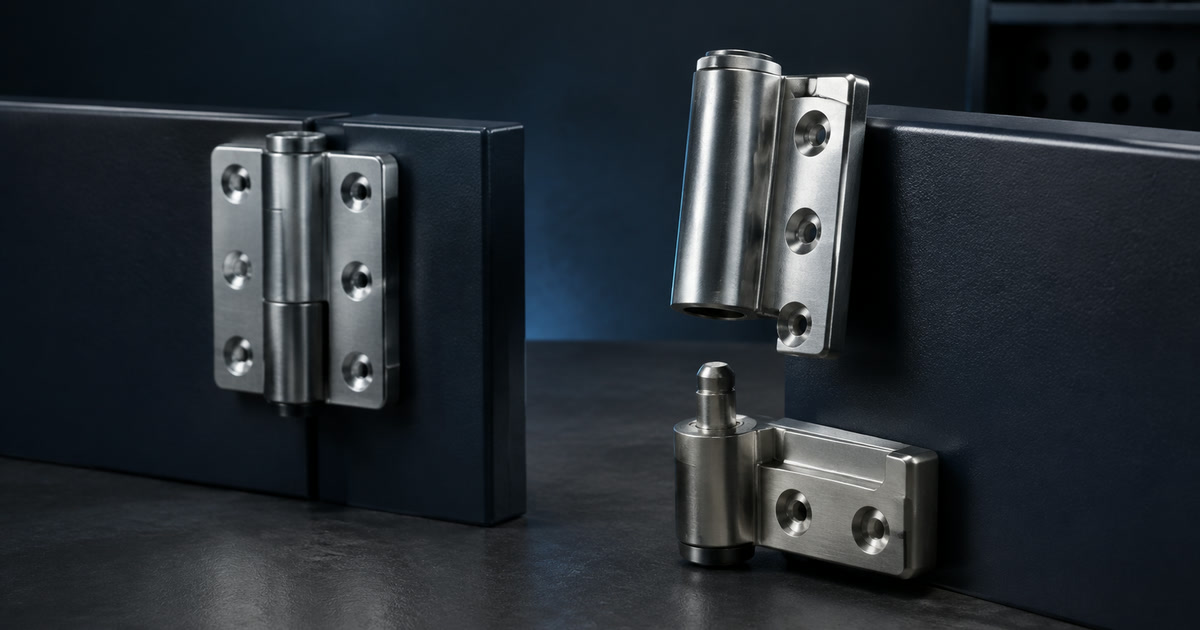
Generic industrial lift-off hinge with two separated leaves beside a removable sheet-metal cabinet door
Editorial illustration of lift-off hinge separation and door removal; not an exact product configuration.

Direct answer

What is a lift-off hinge, and when is it useful?

A lift-off hinge has separable members that allow an opened door to be lifted or withdrawn from the frame without removing mounting fasteners. It can shorten service access time, but the buyer must define removal direction, available clearance, door handling, retention and the installed radial, axial and dynamic load case.

  • State removal direction from a labelled viewed side.
  • Reserve the exact disengagement travel plus handling clearance.
  • Address upward shock and unintended separation with a defined retainer.

Evidence at a glance

Lift-Off Hinge Risks: Vibration, Load Data and Guard Safety

Can upward vibration cause unintended lift-off?

It can when motion or shock acts in the separation direction and the hinge lacks a suitable retainer or limited-lift feature.

Boundary: Risk depends on exact disengagement travel, orientation, mass, acceleration, alignment and the installed retention design.

Buyer action: Describe the dynamic load case and require a retained or permanent arrangement when unintended separation is credible.

Primary sources:

Do published radial and axial values validate the complete door?

No. Values may describe one hinge under defined static conditions and do not automatically validate fasteners, panel reinforcement, fatigue, alignment or dynamic safety factors.

Boundary: The exact manufacturer data and full assembly calculation must remain linked to the stated load direction and setup.

Buyer action: Submit the complete door moment and mounting design, then require candidate-specific arrangement approval and validation.

Does tool-less removal make a machinery guard safe?

No. A removable hinge only changes access mechanics; it does not establish guarding, interlocking, energy isolation or safe manual handling.

Boundary: Machine safety depends on the full risk assessment and applicable guard-system requirements, not the hinge family name.

Buyer action: Have the responsible machine designer define guard retention, interlocks, lockout and the controlled door-removal procedure.

Option comparison

Lift-off hinge vs captive-pin removable hinge: which should I use?

Use lift-off separation when the door has clear withdrawal travel and controlled handling. Use a captive or retractable pin when straight lift space is unavailable or pin retention is important. Both still require load, alignment and safety review.

Lift-off hinge vs captive-pin removable hinge: which should I use?
Decision factorLift-off membersCaptive or retractable pin
Removal motionDoor translates along the separation direction.Pin is withdrawn or retracted before separation.
Space needNeeds clear disengagement travel for the door.Needs pin actuation and member-separation access.
Loose hardwareHinge members remain mounted.Captive design can prevent a loose pin.
Primary riskUnintended lift in the removal direction.Incomplete pin engagement or retention.
Decision basis: TW RFQ comparison based on manufacturer removable-hinge families. Exact disengagement motion, retention and load data remain candidate-specific.

Configurations to compare

Surface In-Line Knuckle

Keeps a straightforward pivot line visible outside the enclosure and needs clear vertical removal travel.

Surface Offset Knuckle

Moves the pivot relative to mounting planes and adds handed offset and sweep checks.

Concealed In-Line

Hides the closed hinge but needs internal space and a compatible removal path.

Concealed Offset

Combines hidden mounting with displaced pivot geometry and more installation constraints.

Captive or Retractable Pin

Supports removal where straight lift clearance is limited while keeping pin control explicit.

Selection factors

Handing, Lift Clearance and Load Inputs for Removable Doors

Lift-Off Hinges RFQ selection factors
FactorWhat to specify
Door load caseProvide size, mass, centre of gravity, orientation, cycles, shock, vibration and proposed hinge spacing.
Radial and axial loadSeparate loads across and along the hinge pin, including credible dynamic and removal-direction forces.
Handing and removalState viewed side, hinge edge, opening direction and desired lift or withdrawal direction.
Disengagement clearanceReserve the exact candidate travel plus assembly and safe manual-handling clearance.
Pivot geometryShow in-line or offset axis and verify door/frame sweep through opening and removal.
MountingDefine holes, threads, fasteners, panel thickness, reinforcement, access and alignment tolerance.
Retention and environmentState corrosion exposure, materials and how unintended lift-off must be prevented.

Installed interface

  1. 01

    Door member

    Mounting, mass, centre of gravity, handing and safe handling points.

  2. 02

    Frame member

    Mounting plane, alignment, stiffness and removal-side clearance.

  3. 03

    Pin and knuckle

    Axis, engagement length, radial/axial loading, wear and lubrication.

  4. 04

    Removal envelope

    Disengagement travel, adjacent equipment, cable or ground strap and operator space.

  5. 05

    Retention system

    Captive feature, fastener, limited-lift geometry or permanent installation control.

Practical answer

Lift-off hinge handing: left or right, and how do I document it?

Use one labelled exterior view and one section. Mark the hinge side, inside and outside faces, door opening direction, pin axis and the arrow for removal. Show the clearance available along that arrow and any retainer. Require the final candidate drawing to repeat the same view convention because Type A, Type B, left and right labels can differ.

  1. Name the viewing side.
  2. Mark inside, outside and hinge edge.
  3. Draw opening and removal arrows.
  4. Dimension disengagement and handling clearance.
  5. Show and approve the unintended-lift retention feature.
Reference basis:

Copy into your request

Lift-Off Hinges RFQ template

Door dimensions, mass and centre of gravity: [ ]
Hinge count, spacing and orientation: [ ]
Viewed-side handing and removal direction: [ ]
Required opening angle and full removal path: [ ]
Disengagement travel and service clearance: [ ]
Radial, axial, shock, vibration and cycle loads: [ ]
Mounting holes, fasteners and panel reinforcement: [ ]
Retention against unintended lift-off: [ ]
Material, finish and environment: [ ]

Application decision

Lift-Off Hinge Choices by Lift Path, Vibration and Door Weight

Lift-Off Hinge Choices by Lift Path, Vibration and Door Weight
Application conditionRFQ direction
Clear vertical lift pathEvaluate a conventional lift-off arrangement and document safe handling clearance.
Restricted lift clearanceCompare a captive or retractable pin rather than forcing an impractical translation.
Mobile or vibrating serviceAdd positive retention against separation-direction shock.
Heavy removable doorDefine lifting aids, handles, centre of gravity and reinstall alignment in addition to hinge capacity.
Safety guardKeep hinge selection subordinate to the machine guarding and access-control design.

Applications to describe in the RFQ

01

Frequently Serviced Cabinets

Define service frequency, safe door handling and a repeatable reinstall/alignment method.

02

HVAC Access Doors

Add filter-change clearance, gasket alignment and field retention requirements.

03

Vehicle Compartments

Address upward shock, vibration, uneven ground, corrosion and captive retention.

04

Machinery Access Doors

Keep removable-hinge convenience separate from the guard, interlock and lockout design.

Buyer questions

Lift-Off Hinges FAQ

Answers without a listed source are TW RFQ editorial guidance, not an external standard or part-specific approval.

How do I select Type A versus Type B?

Type A and Type B are handing conventions that vary between manufacturers, so follow the candidate drawing and state viewed side, hinge side, opening direction and removal direction. See how to document lift-off hinge handing.

How much removal clearance is required?

Use exact disengagement travel from the drawing, then add assembly, hand, lifting and nearby-equipment clearance.

How can unintended lift-off be prevented?

Use a validated retaining fastener, captive feature, limited-lift hinge or permanent arrangement appropriate to the load case.

Can I add more hinges to carry any door?

No. Extra hinges share load unevenly unless they stay aligned, so the full door moment and mounting structure still need review; see how many hinges an enclosure door needs.

Technical reference basis

Sources

What these buyer guides do not establish

Sources last checked: .

Private sourcing review

Have a drawing, photo or reference part?

Send the interface and commercial requirements for a focused Taiwan sourcing review.

Request a Quote