Original RFQ triage framework
Industrial Enclosure Hardware RFQ Readiness Scorecard
Use this RFQ readiness scorecard’s five observable gates to decide whether a request needs basic intake, targeted clarification or an initial manufacturing-candidate review. The score organizes the next action; it does not certify the part or predict a quotation.
Direct answer
When Is an Industrial Enclosure Hardware RFQ Ready for Supplier Outreach?
An enclosure hardware RFQ is ready for initial supplier outreach when it identifies the required function, controls the installed interface, defines performance and evidence, states a comparable commercial scope, and authorizes the files that may be shared. TW RFQ scores those five gates from 0 to 2; an 8–10 total can begin candidate review, but it is not engineering approval or a quotation guarantee.
- Score only information that is visible in the controlled request; do not award points for assumptions.
- Use a low or middle score to name the next clarification instead of rejecting an incomplete buyer inquiry.
- Treat 8–10 as ready for initial review, not as proof of supplier capability, compliance or commercial acceptance.
TW RFQ authored the five-gate score and its thresholds as an intake method. The sources below support the narrower drawing, enclosure-evidence and delivery concepts; they do not publish or endorse this scorecard.
- ASME Y14.5-2018 (R2024) — Dimensioning and Tolerancing — American Society of Mechanical Engineers
- IEC 60529 Ed. 2.2 — Degrees of protection provided by enclosures (IP Code) — International Electrotechnical Commission
- Incoterms® 2020 rules — International Chamber of Commerce
Decision framework
TW RFQ Five-Gate Readiness Scorecard
Score each gate 0, 1 or 2 using the observable conditions below. This is an original TW RFQ intake and triage framework—not an industry standard, certification, supplier qualification or guarantee.
| Readiness gate | 0–2 scoring rule |
|---|---|
| 1. Part and function identity | 0 = only a generic product name; 1 = category and application are known but the action or acceptance result is open; 2 = part family, installed purpose, required action and key acceptance outcome are stated. |
| 2. Installed interface and controlled record | 0 = no usable interface record; 1 = a photo, sample or partial dimensions exist; 2 = the controlling drawing or equivalent record identifies revision, units, mounting, mating geometry, clearances and applicable tolerances. |
| 3. Performance and evidence | 0 = only broad claims such as heavy duty or waterproof; 1 = a target is named but the condition, subject or proof is open; 2 = measurable performance, conditions, acceptance method and required document scope are stated. |
| 4. Commercial scope | 0 = no useful quantity, timing or destination; 1 = some commercial inputs exist but quotations would use different assumptions; 2 = prototype, order and annual volumes, destination, requested timing, packaging and delivery basis are comparable. |
| 5. Confidentiality and sharing authority | 0 = file ownership or sharing permission is unclear; 1 = sensitivity is known but NDA or redaction decisions remain open; 2 = the buyer identifies what may be shared, with whom, at which stage and under what confidentiality condition. |
How the 0–10 Readiness Result Controls the Next Action
Add the five gate scores only after recording the evidence used for each score. A 0–4 request should stay in basic intake while the buyer supplies the missing function, interface and commercial facts. A 5–7 request needs targeted clarification before broad candidate outreach. An 8–10 request can enter an initial manufacturing-candidate review because every gate has enough information to start a controlled conversation.
The total is not a probability of receiving a quote. It does not measure supplier capability, technical compliance, price competitiveness or purchase readiness. A single critical unknown can still stop outreach even when the arithmetic total is high, especially if file-sharing authority, safety requirements or the controlled drawing is unresolved.
- 0–4: continue buyer intake and gather the basic requirement.
- 5–7: ask focused questions and resolve critical unknowns before outreach.
- 8–10: begin initial candidate review while tracking every remaining open item.
Gate 1 — Identify the Part by Its Installed Function
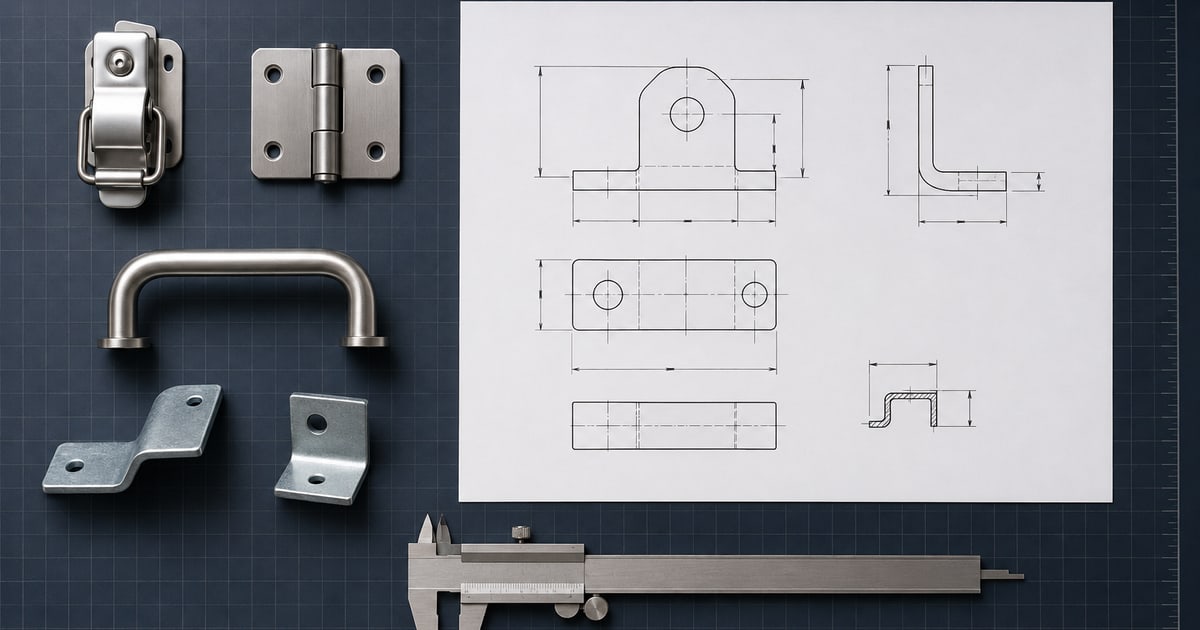
A label such as latch, hinge or handle is enough to route an inquiry, but not enough to judge whether two candidates solve the same problem. State what the hardware must do on the enclosure: apply gasket compression, retain a cover, support a door through a defined motion, carry an assembly or reinforce a mounted component. The detailed guides for compression latches, draw latches, lift-off hinges and recessed and folding handles show how each function becomes a measurable requirement.
The best short description combines the part family, installed application, required action and acceptance result. If the buyer is replacing a reference part, record which characteristics must remain equivalent and which may change instead of treating the reference model as the complete specification.
Gate 2 — Control the Installed Interface
The installed interface connects the component to the door, frame, gasket, panel, fasteners and mating geometry. A controlled record should identify the drawing number and revision, units, cutout or hole pattern, panel thickness, mounting surfaces, clearances and the dimensions that determine fit or motion.
ASME Y14.5 describes a widely used language for communicating dimensions and tolerances. The scorecard does not require that standard for every project; it uses the source to support the broader principle that a quotation package needs an unambiguous, controlled dimensional basis.
- ASME Y14.5-2018 (R2024) — Dimensioning and Tolerancing — American Society of Mechanical Engineers
Gate 3 — Separate Performance from the Evidence Required
Performance needs a value, condition and acceptance method. Replace heavy duty with the actual load case, corrosion resistant with the material or test basis, and waterproof with the exact enclosure classification and installed subject when one is required.
IEC 60529 defines the IP Code for degrees of protection provided by enclosures, while ANSI/NEMA EN 10250 addresses enclosure Types under its own scope. Neither source makes a category-level latch or hinge claim proof for the completed cabinet. Score this gate at 2 only when the request states both the intended result and the evidence the buyer expects to review.
- IEC 60529 Ed. 2.2 — Degrees of protection provided by enclosures (IP Code) — International Electrotechnical Commission
- ANSI/NEMA EN 10250-2024 — Enclosures for Electrical Equipment — Environmental Considerations — National Electrical Manufacturers Association
Gate 4 — Give Every Candidate the Same Commercial Basis
Separate prototype quantity, initial order quantity and estimated annual volume because they can support different process and tooling choices. Add the requested sample or production timing, destination, packaging constraints and the currency or price-break structure needed for comparison.
When an Incoterms rule is used, pair it with the named place and the applicable version. ICC explains that the rules allocate defined delivery obligations, costs and risks; they do not replace the complete sales contract. The score measures whether candidates can quote a common basis, not whether the final terms have already been negotiated.
- Incoterms® 2020 rules — International Chamber of Commerce
Working checklist
Evidence to Record with the Score
- Product family and installed application
- Required mechanical action or functional result
- Controlled drawing, revision and units
- Mounting, mating geometry, clearances and tolerances
- Material, finish and measurable performance conditions
- Acceptance method and document scope
- Prototype, initial-order and annual volumes
- Destination, requested timing, packaging and delivery basis
- Buyer-approved attachments and any required redactions
- NDA timing, permitted audience and unresolved owner
Avoidable risk
Four Ways a Readiness Score Can Mislead
Scoring assumptions as facts
Award points only for buyer-confirmed information in the controlled request and mark every inferred value as open.
Hiding a critical zero in the total
A high total does not override missing file authority, safety requirements or the interface needed to judge fit.
Treating readiness as supplier approval
The score evaluates the request package, not a candidate’s process, capacity, evidence or commercial suitability.
Using one score forever
Rescore when the drawing, quantity, destination, evidence requirement or sharing boundary changes.
Buyer questions
Buyer questions
Is the TW RFQ readiness score an industry standard?
No. It is an original TW RFQ intake and triage framework for choosing the next review action. It is not a certification, engineering approval, supplier qualification or prediction that a manufacturer will quote.
Must every gate score 2 before candidate review begins?
Not always. An 8–10 total can support initial review, but a critical zero can still stop outreach. Sharing authority, safety-critical information and the interface required to judge fit should not be bypassed by the total.
What should a buyer do with a 5–7 score?
Ask only the questions tied to the weak gates, record the responsible person and rescore the controlled request after the answers arrive. The goal is a smaller, traceable clarification cycle rather than a longer generic form.
Does a score of 10 guarantee a quotation?
No. It only means the request contains enough information for initial candidate review under this framework. Supplier interest, capability, capacity, price, lead time, evidence and commercial acceptance remain separate decisions.
- ASME Y14.5-2018 (R2024) — Dimensioning and TolerancingAmerican Society of Mechanical Engineers
Official description of a widely used standard for communicating engineering drawing dimensions and tolerances.
- IEC 60529 Ed. 2.2 — Degrees of protection provided by enclosures (IP Code)International Electrotechnical Commission
Official publication page describing the scope of the IP Code used when an enclosure protection requirement is specified.
- ANSI/NEMA EN 10250-2024 — Enclosures for Electrical Equipment — Environmental ConsiderationsNational Electrical Manufacturers Association
Current standard listing for NEMA enclosure Type requirements and environmental considerations; it supersedes ANSI/NEMA 250-2020.
- Incoterms® 2020 rulesInternational Chamber of Commerce
Official overview of the ICC trade rules used with a named place and version to define a delivery basis.