Low-profile carrying and access hardware

Recessed and Folding Handles for Industrial Enclosures

Recessed and folding handles reduce projection in different ways. The RFQ must first distinguish opening a panel from carrying an assembly, then trace the load through the handle, fasteners, cutout and enclosure.

By · ·

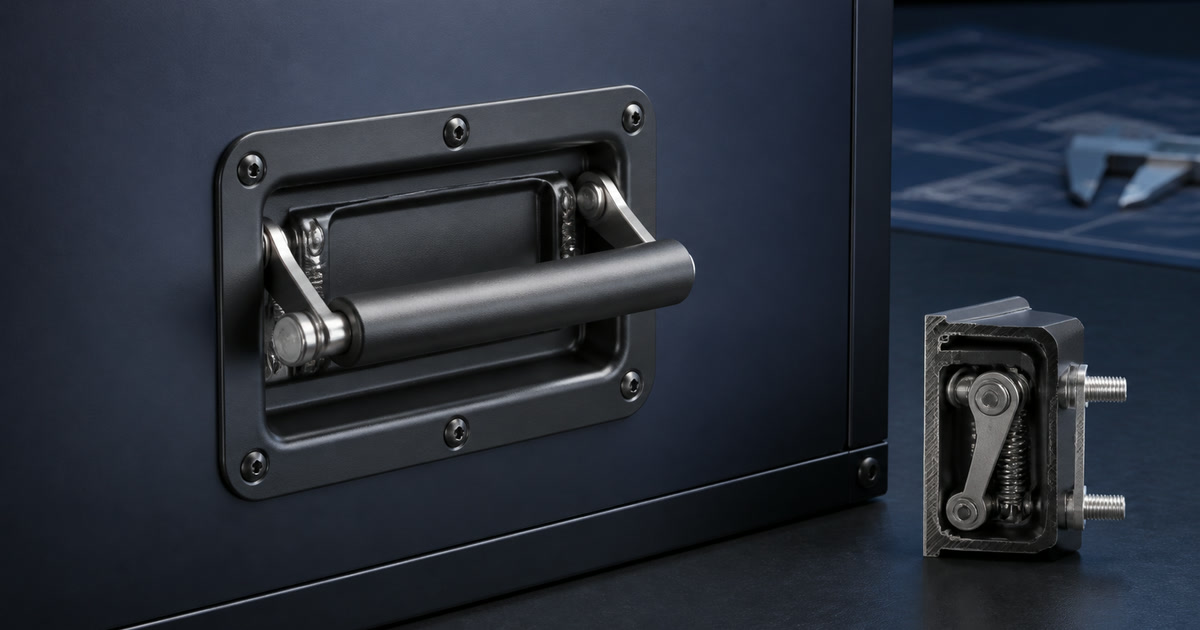
Generic recessed tray handle and folding bail handle mounted on dark industrial sheet-metal panels
Editorial illustration comparing low-profile handle forms; not a lifting certification or supplier model.

Direct answer

Should I choose a recessed handle or a folding handle?

Choose a recessed handle when minimum external projection and storage clearance matter and the enclosure can accept a controlled cutout. Choose a surface folding handle when a tray is unnecessary but the grip must stow after use. In both cases, define whether the handle opens a panel or carries equipment and validate the complete load path.

  • Use a recessed tray only when the panel can accept its cutout and depth.
  • Define spring return, detent or free-folding behaviour explicitly.
  • Validate handle, fasteners, panel and reinforcement as one load path.
Sources for this answer:

Evidence at a glance

Recessed Handle Limits for Lifting, Pinch Risk and Load Transfer

Can a recessed handle lift the complete enclosure?

Only when the exact handle, panel, fasteners, load sharing, dynamic duty and safety factor have been validated for that lifting case.

Boundary: A pull-handle form or model-specific test value does not approve another panel, cutout, reinforcement or load direction.

Buyer action: State complete mass and load path, then request exact-part data and assembly-level validation from the responsible parties.

Primary sources:

Does a spring-return handle eliminate pinch and rattle risks?

No. Return force, pivot clearance, stops, vibration and the surrounding panel determine whether fingers can be pinched or the grip can rattle.

Boundary: The presence of a spring describes a mechanism, not an installed ergonomic or vibration result.

Buyer action: Define the expected user action and vibration, then inspect the exact candidate in a representative panel sample.

Primary sources:

Can published handle load be transferred to a different panel?

Not automatically. Installed capacity can change materially with panel thickness, cutout geometry, reinforcement, fasteners, load direction, load sharing and the manufacturer’s original test fixture.

Boundary: Ultimate or permanent-deformation data are not necessarily safe working limits for the buyer assembly.

Buyer action: Request the test setup and working limit, then validate the real handle-to-panel load path with the required factor.

Primary sources:

Option comparison

Recessed tray vs surface folding handle: what is the trade-off?

A recessed tray minimises exterior projection by consuming panel cutout and interior depth. A surface folding handle avoids the tray but retains mounting feet and some stored projection. Both require a complete load-path review.

Recessed tray vs surface folding handle: what is the trade-off?
Decision factorRecessed traySurface folding
Exterior projectionUsually lowest when stowed.Reduced after folding but feet remain exposed.
Panel preparationControlled tray cutout and edge treatment.Mounting holes or weld locations.
Interior spaceConsumes tray depth and rear clearance.Primarily fastener or stud clearance.
Primary checkCutout reinforcement and sealing.Pivot, stop, stored position and mounting feet.
Decision basis: TW RFQ comparison based on cited manufacturer handle configurations. Exact cutout, projection, return and load values remain model-specific.

Configurations to compare

Snap-In Flush Finger Pull

Supports low opening force within a defined panel-thickness and cutout range; it is not automatically a carry handle.

Spring-Return Recessed Tray

Automatically stows the bail and requires cutout, tray depth, spring, rattle and pinch review.

Detent Recessed Tray

Holds selected positions when the detent force and vibration behaviour suit the user workflow.

Surface Folding Bail

Avoids a tray cutout while adding pivot, stop, stored projection and mounting-foot requirements.

All-Metal Bolt- or Weld-On

Targets harsher duty only when exact load data, weld or fastener design and panel reinforcement are verified.

Selection factors

Cutout, Load and Return Inputs for a Recessed or Folding Handle Quote

Recessed & Folding Handles RFQ selection factors
FactorWhat to specify
User functionState whether the user opens a panel, assists carrying or repeatedly lifts the complete equipment assembly.
Load caseProvide magnitude, direction, handle count, load sharing, shock, target cycles and responsible safety factor.
Panel and cutoutControl material, thickness, cutout dimensions, corner radii, burr direction, finish buildup and reinforcement.
MountingDefine front, rear or weld mounting, fastener grade, thread engagement, access and tightening torque.
Working envelopeState stowed and deployed projection, opening angle, grip span, glove clearance and nearby interference.
Return behaviourSpecify spring return, detent or free motion plus rattle, vibration, stops and pinch-point expectations.
Materials and exposureList handle, pin and spring materials, corrosion, UV, temperature, chemicals and sealing needs.

Installed interface

  1. 01

    User and grip

    Function, glove use, span, orientation, deployment force and pinch clearance.

  2. 02

    Pivot and return

    Pin, spring or detent, stops, rattle, cycles and stored position.

  3. 03

    Tray or mounting feet

    Cutout, depth, holes or welds, fasteners and seal treatment.

  4. 04

    Panel structure

    Thickness, edge quality, stiffness and reinforcement around the load introduction.

  5. 05

    Complete enclosure

    Mass, centre of gravity, load sharing, shock and validation method.

Practical answer

How should I define the load for a recessed or folding handle?

State the complete equipment mass, number and location of handles, orientation, centre of gravity and how users will pull, carry or lift it. Add dynamic handling, target cycles and the responsible safety factor. Then define panel thickness, cutout, reinforcement and fasteners so the handle data are not separated from the real installed load path.

  1. Name opening, carrying or lifting as the function.
  2. Map mass and centre of gravity to each handle.
  3. State direction, shock, cycles and safety factor.
  4. Define handle mounting, cutout and reinforcement.
  5. Request exact test setup and assembly validation.
Reference basis:

Copy into your request

Recessed & Folding Handles RFQ template

Opening, carrying or lifting function: [ ]
Complete equipment mass, handle count and load direction: [ ]
Shock, cycle target and safety factor: [ ]
Panel thickness, controlled cutout and reinforcement: [ ]
Front, rear or weld mounting and fasteners: [ ]
Stowed/deployed envelope and gloved-hand clearance: [ ]
Spring return, detent or free-folding behaviour: [ ]
Pinch, rattle and vibration requirements: [ ]
Materials, finish and environmental exposure: [ ]

Application decision

Recessed Tray or Folding Bail: Choosing by Projection, Cutout and Stowing

Recessed Tray or Folding Bail: Choosing by Projection, Cutout and Stowing
Application conditionRFQ direction
Minimum exterior projectionEvaluate a recessed tray only after cutout, interior depth and reinforcement are acceptable.
No large panel cutoutCompare a surface folding handle with stored projection and pivot clearance controlled.
Automatic stowingSpecify spring-return force, stops, pinch and vibration behaviour.
Selectable handle positionUse a detent requirement with hold force and cycle expectations.
Complete-equipment liftingTreat handle, fasteners, panel and enclosure as an engineered load path.

Applications to describe in the RFQ

01

Portable Instrument Cases

Define total mass, carrying orientation, shock, handle count and packing projection.

02

Mobile Equipment Drawers

Separate drawer operating force from any lifting or restraint function and include vibration.

03

Restricted-Aisle Access Panels

Control deployed sweep, stored projection, knuckle clearance and nearby obstructions.

04

Packed Electrical Enclosures

Use recessed geometry only after internal component, wiring, seal and cutout reinforcement checks.

Buyer questions

Recessed & Folding Handles FAQ

Answers without a listed source are TW RFQ editorial guidance, not an external standard or part-specific approval.

Spring return or detent?

Spring return automatically stows the grip; a detent holds selected positions. Choose from vibration, pinch and intended user behaviour.

What cutout information belongs in the RFQ?

Provide a controlled drawing or DXF, thickness and tolerance, corner radii, burr direction, finish buildup and reinforcement.

Can stainless steel directly replace a polymer version?

Not from material name alone; load, geometry, mounting, corrosion grade, mass, grip temperature and cutout can differ.

Is a recessed tray always more compact?

It reduces exterior projection but consumes internal depth and panel area, so both sides of the enclosure must be checked.

Technical reference basis

Sources

What these buyer guides do not establish

Sources last checked: .

Private sourcing review

Have a drawing, photo or reference part?

Send the interface and commercial requirements for a focused Taiwan sourcing review.

Request a Quote