Manual rotary machine controls

Handwheels with Revolving, Folding or Retractable Handles

A handwheel with a revolving, folding or retractable handle changes how the operator cranks and how far the grip projects, but the wheel still has to match torque, shaft, hub and motion. Unexpected or powered rotation remains a machine-level risk decision.

By · ·

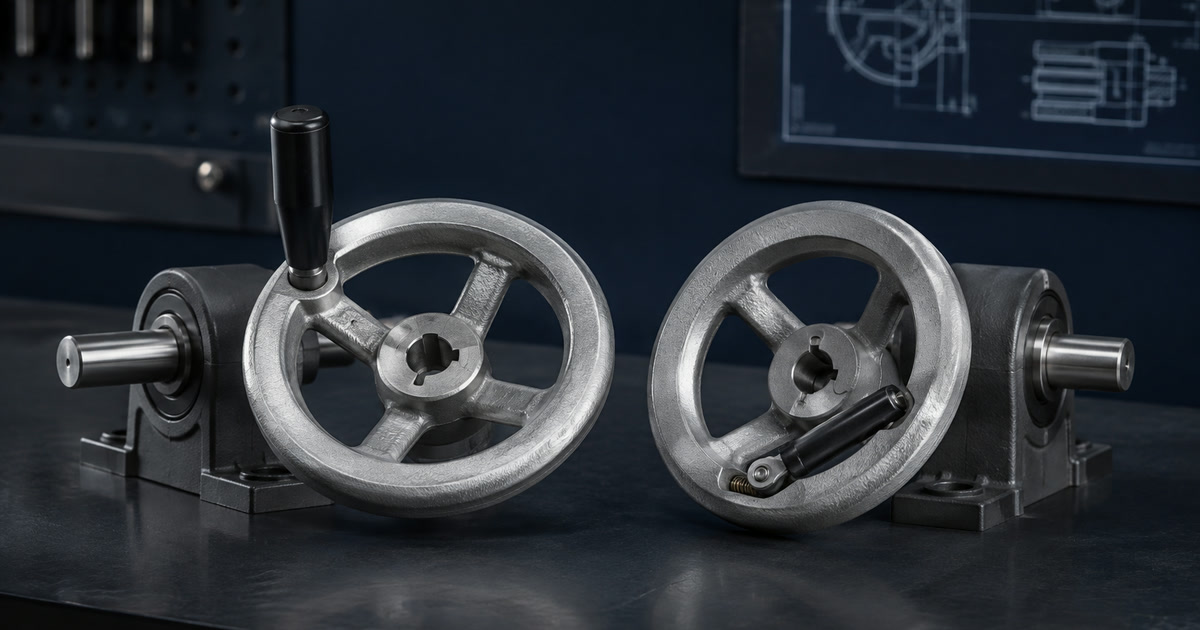
Generic industrial handwheels with revolving grip and folded safety-retractable grip beside a keyed shaft
Editorial illustration of handwheel-handle choices; not a machine-safety certification or supplier model.

Direct answer

When should a handwheel use a revolving or retractable handle?

A revolving handle suits frequent continuous manual rotation. A folding or safety-retractable handle reduces projection and may return out of engagement after release, depending on the exact mechanism. Define torque, wheel diameter, shaft connection, cycles, clearance and whether the wheel can be back-driven or powered; the complete machine still requires risk assessment.

  • Relate wheel radius to required shaft torque and acceptable operator force.
  • Control bore, key or flat, hub length and axial retention as one interface.
  • Treat back-driven or powered rotation as a machine hazard, not a handle-feature shortcut.

Evidence at a glance

Handwheel Torque Data and Powered-Rotation Safety

Does a published handwheel torque validate the shaft and machine?

No. A model-specific wheel value does not establish the shaft, key, hub, axial retainer, operator condition or the machine’s dynamic load case.

Boundary: Manufacturer data remain tied to the exact part and stated test condition; complete assembly strength requires separate review.

Buyer action: Define real torque and motion, then validate every interface in the wheel-to-machine load path.

Primary sources:

Can a projecting handwheel grip be safe during powered rotation?

A projecting grip can create strike, entanglement, shear or nip hazards when the handwheel moves unexpectedly, is back-driven or remains connected during powered rotation.

Boundary: A revolving or retractable handle name does not certify the complete machine or replace guarding and energy control.

Buyer action: Have the responsible machine designer assess motion, stopping and access before permitting any connected handwheel arrangement.

Does “safety retractable handle” certify the machine?

No. It describes a handle mechanism that may retract or disengage under defined use; the complete machine remains subject to its own risk assessment.

Boundary: Exact return behaviour and limits belong to the selected model, while guarding and interlocking are system decisions.

Buyer action: Verify the exact mechanism and integrate it into the documented machine risk-reduction design.

Option comparison

Revolving vs retractable handwheel handle: what is the difference?

A revolving grip stays projected and rotates around its own pin during continuous cranking. A folding or safety-retractable grip reduces projection after use, with return and engagement behaviour determined by the exact mechanism.

Revolving vs retractable handwheel handle: what is the difference?
Decision factorRevolving handleFolding or retractable handle
CrankingReady for continuous manual rotation.May require deployment or continued engagement.
Stored projectionRemains projected.Reduces projection after stowing or release.
Mechanism inputGrip pin, bearing and free rotation.Fold lock, spring, return and engagement sequence.
Safety boundaryFull rotating envelope needs review.Retraction reduces one exposure but does not certify the machine.
Decision basis: TW RFQ comparison based on cited handwheel configurations. “Safety” terminology and mechanism behaviour remain tied to the exact model and machine context.

Configurations to compare

Polymer Solid Disc with Revolving Grip

Supports frequent manual rotation when torque, temperature, chemicals and exact part limits are suitable.

Aluminium Solid Disc

Provides a rigid compact wheel with bore, hub, finish and imbalance requirements.

Spoked Metal Handwheel

Offers rim access while introducing spoke, nip and entanglement considerations.

Locking Fold-Away Handle

Stows after deliberate folding and needs lock position, clearance and misuse review.

Spring Safety-Retractable Handle

Requires continued operator engagement in some designs, but exact return and disengagement must be verified.

Selection factors

Torque, Hub and Handle Inputs for a Handwheel Quote

Handwheels with Revolving or Retractable Handles RFQ selection factors
FactorWhat to specify
Torque and ergonomicsState required shaft torque, wheel diameter, handle radius and acceptable operator tangential force.
Shaft and hubDefine bore and tolerance, keyway or flat, set screw, hub length and axial retention.
Motion stateState manual-only, back-driven or powered rotation plus speed, residual energy and stopping behaviour.
Handle mechanismChoose revolving, locking fold-away or safety-retractable action and define the release sequence.
Operating envelopeProvide rim and grip dimensions, gloves, posture, nearby structure and full rotating sweep.
Materials and exposureList wheel, hub and handle materials, corrosion, washdown, chemicals and temperature.
Duty and validationState cycles, impact, vibration, runout, inspection and assembly-level safety validation.

Installed interface

  1. 01

    Operator and grip

    Force, posture, gloves, revolving bearing and engagement action.

  2. 02

    Wheel and rim

    Diameter, disc or spokes, strength, runout and rotating envelope.

  3. 03

    Hub

    Length, material, bore, key or flat and set-screw relationship.

  4. 04

    Shaft and retention

    Tolerance, transmitted torque, axial loads and retained position.

  5. 05

    Machine motion

    Manual, back-driven or powered state, speed, stopping, guards and residual energy.

Practical answer

How should handwheel diameter be related to required torque?

Start with the maximum required shaft torque and divide it by the effective handle radius to estimate ideal tangential force, then account for friction, posture, gloves, duty and a responsible ergonomic limit. Choose a wheel only after checking hub capacity, full rotating clearance and machine motion; a larger radius reduces force but increases envelope and kinetic exposure.

  1. Measure worst-case shaft torque.
  2. Choose a tentative effective handle radius.
  3. Estimate tangential hand force.
  4. Apply realistic friction, posture and duty factors.
  5. Validate hub, clearance, speed and machine risk.
Reference basis:

Copy into your request

Handwheels with Revolving or Retractable Handles RFQ template

Required shaft torque and operating range: [ ]
Wheel diameter and handle radius: [ ]
Acceptable operator force and posture: [ ]
Bore, tolerance, keyway/flat and hub length: [ ]
Set screw and axial-retention method: [ ]
Manual, back-driven or powered rotation state: [ ]
Revolving, fold-away or retractable action: [ ]
Speed, cycles, impact and vibration: [ ]
Full rotating envelope, guards and nearby hazards: [ ]

Application decision

Revolving, Folding or Retractable Handle: Choosing by Duty and Motion

Revolving, Folding or Retractable Handle: Choosing by Duty and Motion
Application conditionRFQ direction
Frequent manual crankingCompare a revolving grip with ergonomics, bearing wear and rotating envelope controlled.
Projection after use is unacceptableEvaluate a locking fold-away mechanism and user stowing behaviour.
Unexpected rotation is credibleConsider disengagement or retractable options only within the machine-level risk assessment.
High required torqueBalance wheel radius and operator force against hub strength and available envelope.
Powered shaftDefine disconnection, guarding and energy control before sourcing the handwheel.

Applications to describe in the RFQ

01

Lead-Screw Positioning

Define torque across travel, backlash, manual speed and any back-driving behaviour.

02

Valve and Damper Actuation

Add torque peaks, position indication, outdoor exposure and retained energy.

03

Press, Roll and Fixture Setup

Identify powered motion, nip zones and guarding before selecting a projecting grip.

04

Stops and Guide Adjustments

Control bore, retention, repeated setting and clearance within the operator station.

Buyer questions

Handwheels with Revolving or Retractable Handles FAQ

Answers without a listed source are TW RFQ editorial guidance, not an external standard or part-specific approval.

When should I choose a retractable handle?

When projection or unexpected wheel motion is a concern and the exact mechanism’s return behaviour fits the risk assessment.

Can the handwheel remain connected while a motor drives the shaft?

Only when the machine design explicitly permits it; disengagement, guarding or another engineered measure may be required.

Solid-disc or spoked handwheel: what changes?

A solid disc is a closed, compact wheel whose RFQ inputs are bore, hub, finish and balance. A spoked wheel gives rim access but leaves open spokes that add nip and entanglement points to the risk assessment. Size either one from the required torque and handle radius.

Is a keyway enough to secure the wheel?

No. Bore/key tolerances, torque, hub length, materials, set or retaining features and axial retention must all be defined.

Technical reference basis

Sources

What these buyer guides do not establish

Sources last checked: .

Private sourcing review

Have a drawing, photo or reference part?

Send the interface and commercial requirements for a focused Taiwan sourcing review.

Request a Quote