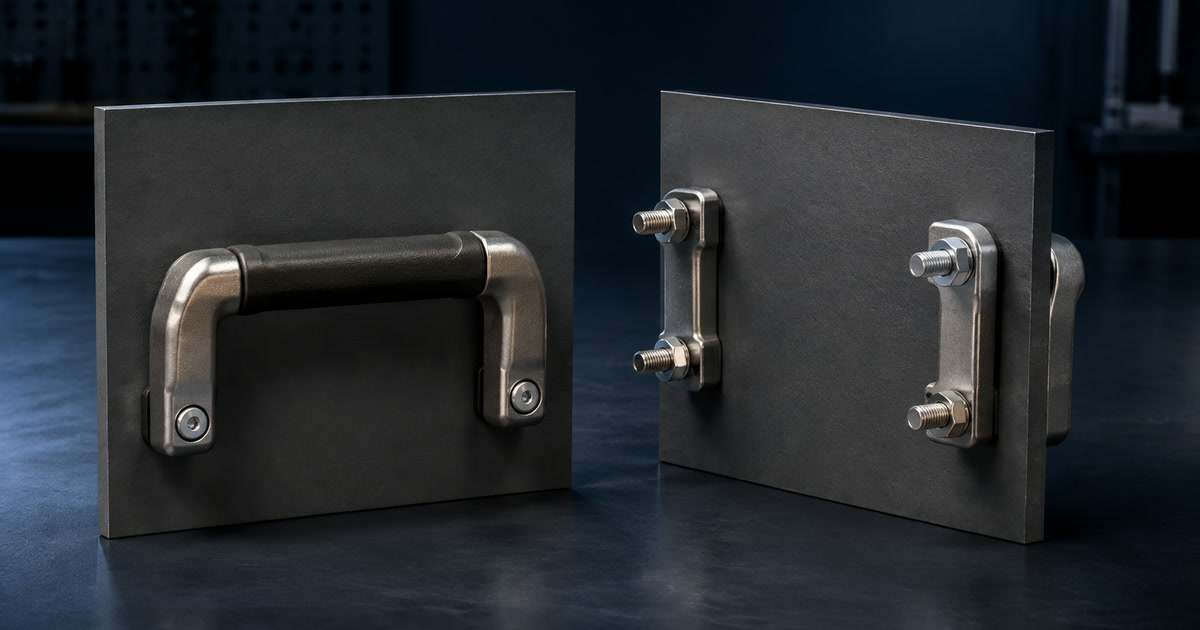
Fixed cabinet and machine handles

Industrial Pull Handles for Cabinet Doors and Panels

An industrial pull handle must match more than overall length: its mounting centres, hole form, grip clearance, projection, fastener access and the load path through the panel.

By · ·

Generic U-shaped and arched industrial pull handles installed on sheet-metal cabinet door samples
Editorial illustration of industrial pull-handle configurations; not a lifting point or stock claim.

Direct answer

How should an industrial pull handle be selected?

Select an industrial pull handle by mounting centres, grip clearance, mounting side, load direction, substrate construction and exposure environment—not appearance alone. Capacity belongs to the complete handle, fastener and panel assembly, so identify operating and foreseeable misuse loads and request assembly-level validation when failure could injure a person or release a guard.

  • Control centre-to-centre spacing and hole type, not only overall length.
  • State front or rear mounting, thread engagement and installation access.
  • Separate opening force from lifting, restraint or safety-related loads.
Sources for this answer:

Evidence at a glance

Pull Handle Load Data, Lifting Use and Guard Compliance

Can load data for one pull handle be used for another size?

No. Manufacturer F1 and F2 values apply to defined models, directions and fixtures and should not be interpolated to another centre, mounting or panel.

Boundary: Even exact handle data do not establish the buyer’s fasteners, thread engagement, panel stiffness or reinforcement.

Buyer action: Request model-specific direction data and validate the complete installed assembly for the real load case.

Primary sources:

Is a cabinet pull handle suitable as a lifting or tie-down point?

Not unless the exact product and installation were specifically designed and validated for that function; ordinary operating handles are not lifting eyes or anchors.

Boundary: Appearance and material do not establish a rated hoisting, restraint, fall-protection or cargo-securement function.

Buyer action: Use purpose-designed certified hardware when the requirement is lifting or restraint, and state the governing load case.

Primary sources:

Does adding a handle make a machine guard compliant?

No. The handle supports user operation, while access, retention, pinch, interlock and risk-reduction decisions remain properties of the complete machine guard system.

Boundary: ISO 12100 addresses machinery risk assessment at system level and does not certify a handle selection.

Buyer action: Have the responsible machine designer integrate the handle into the documented guard and risk-reduction design.

Primary sources:

Option comparison

Rear-mounted vs front-mounted pull handle: which should I specify?

Rear mounting keeps fasteners hidden and requires access behind the panel plus adequate thread engagement. Front mounting enables service-side installation but exposes fastener heads and needs controlled through-hole or counterbore geometry.

Rear-mounted vs front-mounted pull handle: which should I specify?
Decision factorRear mountedFront mounted
Fastener visibilityHidden on the front face.Heads remain visible or capped.
Assembly accessNeeds access behind the panel.Can be serviced from the front.
InterfaceTapped handle holes and engagement depth.Through holes, counterbores and nuts or tapped panel.
Common mistakeIgnoring blind-hole depth.Ignoring head projection and rear retention.
Decision basis: TW RFQ comparison based on cited handle mounting configurations. Exact hole, thread and load data remain candidate-specific.

Configurations to compare

Rear-Mounted U-Handle

Hides fasteners but requires interior access, controlled thread depth and adequate engagement.

Front-Mounted U-Handle

Supports service-side installation through counterbored or through holes while leaving screw heads exposed.

Extruded Arched Handle

Combines a shaped grip and mounting legs with exact centre, section and finish choices.

Modular Tubular Handle

Uses a tube and separate legs, so joints, tube length, alignment and end retention require review.

Bent Stainless Bar

Provides a simple cleanable form when bend geometry, weld or thread quality and grade are controlled.

Selection factors

Load, Hole Centers and Grip Clearance Inputs for a Pull Handle Quote

Industrial Pull Handles RFQ selection factors
FactorWhat to specify
Operating loadState door or drawer force, load direction, frequency, impact and foreseeable misuse separately from lifting.
Mounting centresDimension centre-to-centre distance, hole diameter and tolerance, alignment and permissible overall projection.
Grip envelopeSpecify grip section, usable span, knuckle clearance, glove allowance and nearby obstructions.
Fasteners and accessDefine front or rear mounting, fastener size and grade, thread depth, washers and tightening torque.
Panel structureProvide thickness, stiffness, reinforcement and rear-face access at both mounting points.
Material and finishState base material or grade, coating, colour, texture and cosmetic surface expectations.
Service environmentDescribe corrosion, washdown, chemicals, temperature, hygiene, vibration and pinch clearance.

Installed interface

  1. 01

    Hand envelope

    Grip section, usable span, gloves, knuckle clearance and nearby pinch points.

  2. 02

    Handle body and legs

    Material, geometry, mounting centres, projection and finish.

  3. 03

    Fasteners

    Front or rear access, size, grade, thread depth, washers and torque.

  4. 04

    Panel

    Hole form, tolerance, thickness, local stiffness and reinforcement.

  5. 05

    Door or drawer system

    Operating force, misuse, cycles, impact and any safety-system boundary.

Practical answer

What measurements are needed to replace an industrial pull handle?

Record mounting centres, hole diameter and type, front or rear fastener access, screw size, pitch, available thread depth, grip span and section, knuckle clearance and total projection. Add panel thickness, reinforcement and load direction. Matching centre distance alone can still produce a handle that cannot mount, clears poorly or overloads the panel.

  1. Measure centres from hole axes.
  2. Identify through, counterbored or tapped holes.
  3. Record fastener and usable thread engagement.
  4. Measure grip and full projection envelopes.
  5. Document panel structure and real load direction.
Reference basis:

Copy into your request

Industrial Pull Handles RFQ template

Opening/pushing/pulling function and force: [ ]
Foreseeable misuse load and direction: [ ]
Mounting centres and hole tolerances: [ ]
Front or rear mounting and fastener details: [ ]
Grip section, usable span and knuckle clearance: [ ]
Overall projection and interference envelope: [ ]
Panel thickness, stiffness and reinforcement: [ ]
Material, finish, colour and appearance surface: [ ]
Environment, washdown, vibration and target cycles: [ ]

Application decision

Pull Handle Choices by Mounting Access, Use and Environment

Pull Handle Choices by Mounting Access, Use and Environment
Application conditionRFQ direction
Clean exterior faceUse rear mounting only with interior access and verified engagement depth.
Front-only service accessControl exposed fasteners, through-hole geometry and rear retention.
Gloved frequent operationPrioritise usable span, section, knuckle clearance and surface texture.
Corrosive washdownSpecify exact grade, mating hardware, drainage and cleaning chemicals.
Lifting or restraint loadRoute to purpose-designed rated hardware instead of assuming a cabinet pull is suitable.

Applications to describe in the RFQ

01

Control-Cabinet Doors

Define opening force, seal drag, mounting access and any bonding or hygiene constraint.

02

Machine Access Doors

Keep handle function separate from guard retention and interlock requirements.

03

Industrial Drawers and Carts

State push/pull direction, repeated impacts, gloves and surrounding pinch zones.

04

Instrument Housings

Control projection, finish, fastener visibility and the actual panel load path.

Buyer questions

Industrial Pull Handles FAQ

Answers without a listed source are TW RFQ editorial guidance, not an external standard or part-specific approval.

Front or rear mounting?

Rear mounting hides fasteners but needs interior access and thread engagement; front mounting improves service access but exposes screw heads.

How much hand clearance is enough?

Specify glove type, grip orientation, knuckle envelope and nearby obstructions instead of relying on overall height alone.

Are rear-mounted handles harder to replace in the field?

Usually. A rear-mounted handle is fastened from behind the panel, so replacement needs access to the rear face and screws of the right length for the tapped holes; a front-mounted handle can be changed from the service side but leaves screw heads exposed or capped. For a replacement, also send the measurements needed to replace a pull handle.

Does stainless steel automatically make a handle suitable outdoors?

No. Grade, surface condition, mating fasteners, drainage, chlorides and cleaning regime all affect performance.

Technical reference basis

Sources

What these buyer guides do not establish

Sources last checked: .

Private sourcing review

Have a drawing, photo or reference part?

Send the interface and commercial requirements for a focused Taiwan sourcing review.

Request a Quote