Supplier evaluation guide
How to Evaluate Taiwan Enclosure Hardware Manufacturing Candidates
Evaluate Taiwan enclosure hardware suppliers one question at a time: a company registration confirms an identity, not capability for your part. Check the legal entity, actual process route, controlled documents, inspection plan and commercial assumptions as separate questions.
Direct answer
How Should a Buyer Evaluate a Taiwan Enclosure-Hardware Supplier?
Verify three layers separately: who the company is, what it will actually manufacture or subcontract, and what evidence it can provide for your exact drawing and order. A factory is not automatically suitable, and a trading company is not automatically unsuitable; the buyer needs a transparent responsibility map and comparable quotation basis.
- Verify the legal entity, payee, exporter and current registration status.
- Map each actual manufacturing, subcontract and inspection responsibility.
- Connect capability evidence to the exact drawing, revision, process and order basis.
The Taiwan registries below support legal-identity and exporter checks only. The three-layer and nine-point review are TW RFQ editorial frameworks, not a government supplier approval or official qualification program.
- Company and business registration public inquiry — Administration of Commerce, Taiwan Ministry of Economic Affairs
- Exporter and importer registration system — International Trade Administration, Taiwan Ministry of Economic Affairs
Decision framework
TW RFQ Nine-Point Manufacturing Candidate Review
Record each result as confirmed, open or not applicable. Do not convert an unanswered question into an assumed capability.
| Review layer | Evidence to confirm |
|---|---|
| Registered identity | Match Chinese and English names, registration number, status, address, payee and quotation entity. |
| Export role | Confirm which entity contracts, invoices and exports, and check official exporter/importer registration when relevant. |
| Process ownership | Map cutting, forming, stamping, casting, machining, finishing, assembly and inspection to in-house or approved external sources. |
| Document control | Confirm drawing revision receipt, review, release, translation, change approval and obsolete-document control. |
| Inspection capability | Connect critical characteristics to equipment, method, sampling, records and calibration status. |
| Sample approval | Define prototype, first article or sample records and the conditions required before production release. |
| Tooling control | State ownership, location, maintenance, life assumptions, modification authority and disposition. |
| Change management | Require approval before changing materials, processes, tooling, subcontractors or manufacturing location. |
| Commercial execution | Compare MOQ, price basis, Incoterm, tooling, samples, packaging, capacity and lead-time assumptions on the same scope. |
1. Verify the Exact Contracting Entity
Start with the legal name that will issue the quotation and receive payment. Taiwan companies may use Chinese and English names in different contexts, so match the names to a registration number, current status and registered address. Also check whether the quotation, bank beneficiary and export documents will use the same entity.
Official registration data is an identity check, not a quality approval. It does not prove that the company owns a factory, controls a particular process or has made the requested component before.
- Chinese legal name and English trading name
- Unified Business Number or other registration identifier
- Current registration status and address
- Quotation entity, contracting entity, payee and exporter
- Company and business registration public inquiry — Administration of Commerce, Taiwan Ministry of Economic Affairs
- Exporter and importer registration system — International Trade Administration, Taiwan Ministry of Economic Affairs
2. Map the Real Manufacturing Route
Ask which operations are performed at the quoted site and which are subcontracted. Enclosure hardware can combine stamping, laser cutting, forming, die casting, machining, heat treatment, plating, powder coating, insert installation and assembly. The relevant question is who controls each operation and its acceptance criteria.
A transparent trading or integration role can be useful when responsibilities are clear. Likewise, owning equipment does not prove capability for an exact geometry or tolerance. Compare the proposed process to the drawing, quantities and evidence needs.
- Process and site for every major operation
- Approved external processors and how they are controlled
- Prototype route versus intended production route
- Capacity, tooling and bottleneck assumptions behind the lead time
3. Test Drawing and Revision Control Early
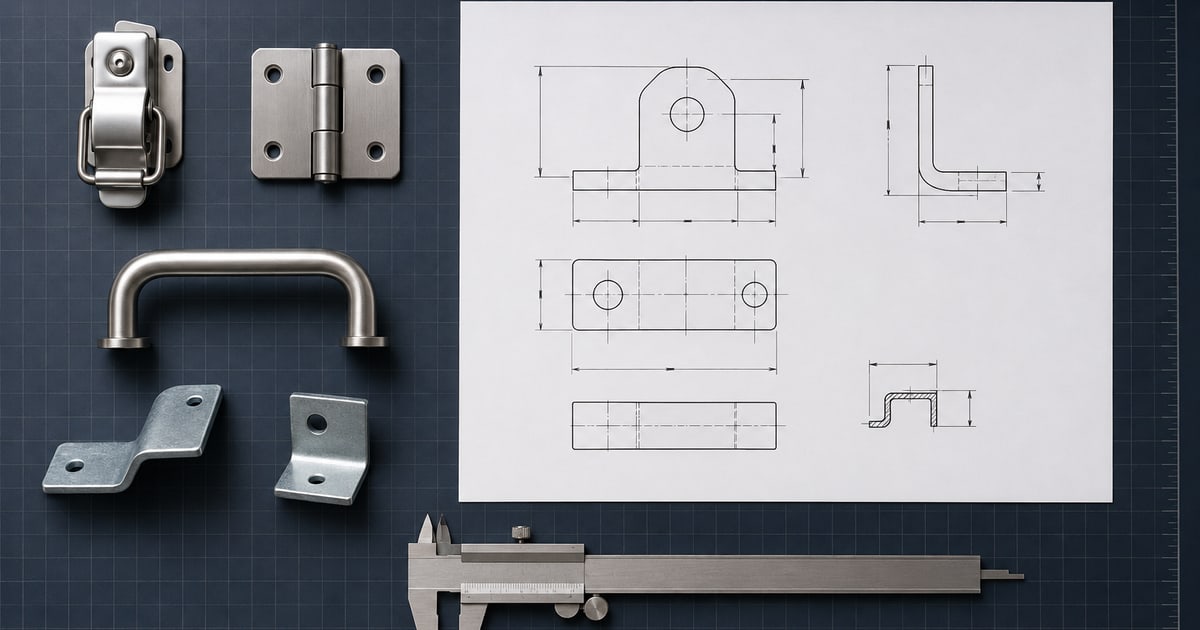
Send a controlled RFQ package with a drawing number, revision and units. Ask the candidate to acknowledge the revision and list assumptions or deviations in writing. This reveals whether commercial and technical teams are evaluating the same requirement.
For custom sheet-metal brackets and metal stampings, a 3D model can communicate shape while the 2D drawing carries material, tolerances, datums, finish and inspection notes. Define which file controls if the two disagree.
4. Connect Inspection to Critical Characteristics
A list of measuring equipment is not an inspection plan. Mark the characteristics that control fit, function, safety or downstream assembly, then ask how each will be measured and recorded. Include fixtures, gauges, access limitations and measurement conditions where relevant.
If a management-system certificate matters, verify the certificate number, status, scope, site and issuing body. ISO itself does not certify organizations; its official guidance points buyers to the issuing body, accreditation body or IAF CertSearch for verification.
- Characteristic and drawing reference
- Measurement method and equipment
- Sampling frequency and acceptance rule
- Record format, retention and lot traceability
- Calibration status for relevant equipment
- How to verify accredited management-system certification — International Organization for Standardization
- Certificate verification guide — IAF CertSearch
5. Define Sample and Production Approval Gates
Separate prototype approval from production-process approval. A laser-cut sample may validate fit while a later stamped part introduces different tooling, edge, flatness or dimensional behavior. The RFQ should say whether the sample must come from production-intent tooling and processes.
Record what approval means: dimensions, material, finish, operation, assembly fit, packaging and required documents. Approval of one characteristic should not be interpreted as blanket acceptance of every deviation.
6. Make Tooling Ownership and Change Control Explicit
For a dedicated die, fixture or gauge, state who pays, who owns it, where it remains, how it is identified and maintained, what life assumption is quoted and who may authorize changes. Clarify whether replacement, storage or transfer costs are included.
Require written approval before changes to material source, process, tooling, subcontractor or production location when they can affect fit, function, appearance or evidence. Ask how lots are identified so a later issue can be traced to the applicable configuration.
7. Normalize the Commercial Comparison
A low unit price can conceal different tooling, sample, inspection, packaging or delivery assumptions. Compare candidates on a normalized scope and identify every exclusion. State currency, tax treatment, Incoterm, destination, quantity breaks and quotation validity.
Lead time should identify its starting event, such as approved drawing, deposit, material receipt or sample approval. Separate tooling, first sample and production lead times so the project schedule can be evaluated realistically.
Working checklist
Buyer Evaluation Record
- Registration identity and current status checked
- Quotation, contract, payee and export entities aligned
- Manufacturing and subcontract process map received
- Exact drawing revision acknowledged
- Assumptions, exclusions and substitutions listed
- Critical-characteristic inspection plan reviewed
- Relevant certificates verified for scope and status
- Prototype and production approval gates separated
- Tooling ownership, maintenance and life assumptions recorded
- Change-notification and traceability expectations accepted
- MOQ, price, Incoterm, packaging and lead-time basis normalized
- No payment decision based only on a website or email identity
Avoidable risk
Four Signals That Need Clarification
The company name changes between documents
Pause and reconcile the quotation entity, payee, registration identity and exporter before payment.
Every process is described as in-house
Request a process-by-process site map and ask how external finishing or special processes are controlled.
The quote says “per drawing” but lists no revision
Require an acknowledged drawing number and revision plus written assumptions and deviations.
A certificate is supplied without matching scope
Verify the certificate status, covered site, activity, issuing body and relevance to the quoted work.
Buyer questions
Buyer questions
Is a registered Taiwan company automatically a manufacturer?
No. Registration confirms company identity and status. Ask where each quoted process is performed and which entity controls production and inspection.
Should I reject a trading company?
Not solely because of its role. Evaluate whether responsibilities, factory access, document control, quality evidence and commercial accountability are transparent and suitable for the project.
How can I check an ISO certificate?
Match the certificate number, company, site, scope, standard, status and issuing body. Use the issuing or accreditation body, or IAF CertSearch where applicable.
Is a sample enough to approve mass production?
Only if the approval plan says so and the sample represents the intended production tooling, process and materials. Otherwise treat fit samples and production-process approval as separate gates.
- Company and business registration public inquiryAdministration of Commerce, Taiwan Ministry of Economic Affairs
Official public source for checking Taiwan company or business registration data.
- Exporter and importer registration systemInternational Trade Administration, Taiwan Ministry of Economic Affairs
Official source for basic exporter/importer registration inquiries and English-name checks.
- How to verify accredited management-system certificationInternational Organization for Standardization
ISO guidance on certification roles and checking accredited certificates through appropriate sources.
- Certificate verification guideIAF CertSearch
Official verification workflow for checking management-system certificate details and status in IAF CertSearch.
- ASME Y14.5-2018 (R2024) — Dimensioning and TolerancingAmerican Society of Mechanical Engineers
Official description of a widely used standard for communicating drawing dimensions and tolerances.