Over-center closure hardware

Draw and Toggle Latches for Enclosure Doors and Lids

Draw latches and toggle latches are over-center enclosure latches that pull two closure members together; in enclosure hardware the names usually describe the same part. Do not confuse either with a fixture-mounted workholding toggle clamp, which solves a different load and safety problem.

By · ·

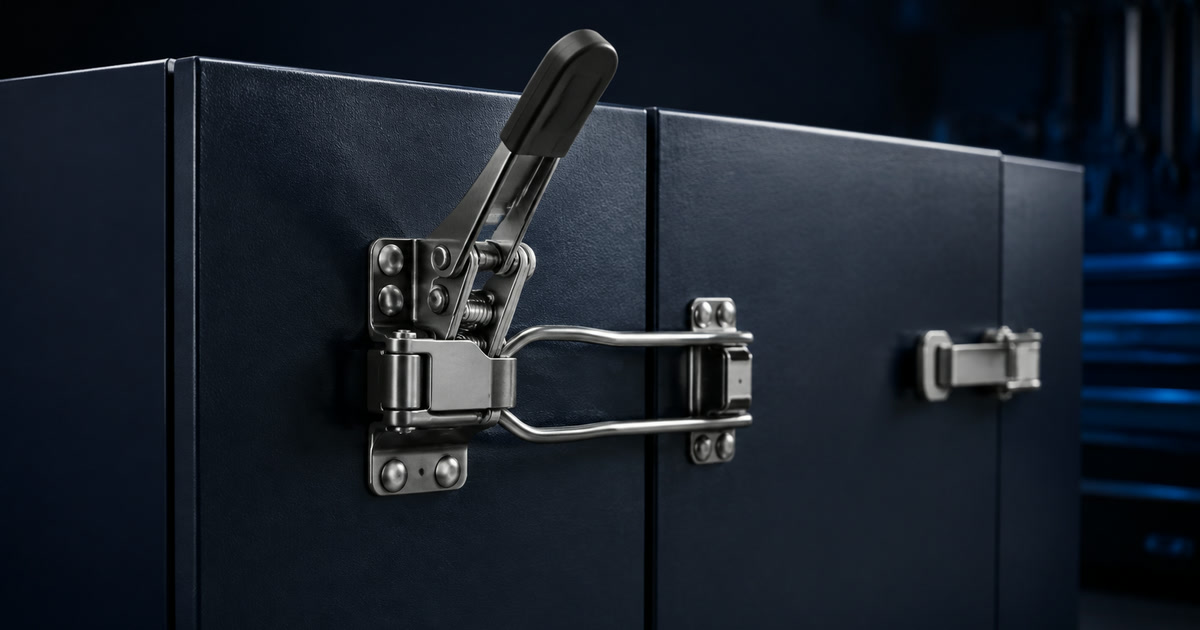
Generic over-center draw latch and keeper mounted across two industrial sheet-metal enclosure panels
Editorial illustration of an enclosure draw-latch interface; not a workholding clamp or supplier catalog model.

Direct answer

Is an enclosure draw latch the same as a toggle clamp?

No. An enclosure draw or toggle latch uses a lever and link, bail or hook to pull a lid or panel toward a keeper and hold it over center. A workholding toggle clamp is fixture-mounted to press or position a workpiece during manufacturing, so its force definitions, interfaces and safety questions are different.

  • Define the two mounting planes and closed latch-to-keeper dimension.
  • State required tension, gasket compression and adjustment range.
  • Keep enclosure closure separate from workholding-fixture terminology.
Sources for this answer:

Evidence at a glance

Draw Latch Questions About Clamping, Accidental Opening and Environment

Why should a draw latch not be specified as a workholding toggle clamp?

The two mechanisms serve different systems: a draw latch joins closure members, while a workholding clamp restrains a production workpiece against a fixture.

Boundary: Similar over-center motion does not make clamp force, mounting geometry or safety terminology transferable between the products.

Buyer action: State whether the requirement closes an enclosure or holds a workpiece before sending drawings to candidates.

Primary sources:

Does over-center action prevent every accidental opening?

No. Retention still depends on keeper alignment, adjustment, fastener pull-out strength, mounting structure and the actual shock and vibration environment.

Boundary: A mechanism description is not an assembly-level dynamic test or a security certification.

Buyer action: Define the credible opening load and request exact-part data plus an installed retention validation.

Primary sources:

Can a flexible draw latch be chosen without environment data?

No. Elastomer temperature, chemicals, UV, ageing and sustained tension can change force and life even when the initial geometry fits.

Boundary: Material-family descriptions cannot predict life in an unspecified fluid, temperature cycle or outdoor exposure.

Buyer action: List the actual exposure and request the exact elastomer specification, limits and service-life evidence.

Primary sources:

Option comparison

Fixed vs adjustable draw latch: which better fits an enclosure?

A fixed draw latch suits a stable mounting relationship and defined closed tension. An adjustable latch suits a bounded variation or service-setting need, but its range, locking method and target setting must be controlled.

Fixed vs adjustable draw latch: which better fits an enclosure?
Decision factorFixedAdjustable
InterfaceStable closed mounting distance.Defined variation or service-setting range.
Control inputMounting position and keeper geometry.Range, target setting and locking method.
ServiceSimpler with fewer setting changes.Can compensate for wear only within approved limits.
Common mistakeIgnoring tolerance and gasket set.Leaving the required tension undefined.
Decision basis: TW RFQ comparison synthesized from manufacturer draw-latch families. Exact adjustment, load and retention behaviour remain model- and installation-specific.

Configurations to compare

Fixed-Grip Wire Bail

Uses a fixed link where panel relationship and closed tension are tightly controlled.

Adjustable Threaded Hook

Adds a defined setting range for gasket variation, service wear or production tolerance.

Flexible Elastomer T-Handle

Accommodates limited movement while adding material-specific temperature, chemical and ageing questions.

Heavy-Duty Hook or Claw

Addresses higher closure demands only when exact load direction, mounting and candidate data are verified.

Low-Profile or Secondary-Catch

Reduces projection or resists unintended opening without automatically providing keyed security.

Selection factors

Keeper, Closed Dimension and Tension Inputs for a Draw Latch Quote

Draw & Toggle Latches RFQ selection factors
FactorWhat to specify
Panel relationshipShow whether the latch and keeper mount coplanar, offset or at right angles, including bends and edge conditions.
Closed dimensionDimension latch-body to keeper mounting references in the fully closed condition and state adjustment range.
Tension and dynamicsState required working tension, shock, vibration, target cycles and responsible safety margin.
Compression and alignmentDefine gasket deflection, allowable misalignment and whether compliance is required in the link.
Operating envelopeProvide handle sweep, opening force, glove clearance, snag risk and pinch constraints.
Material and exposureState metal or elastomer materials, finish, temperature, chemicals, salt and outdoor conditions.
Keeper and accessControl keeper geometry, mounting, secondary catch and any padlock or tamper requirement.

Installed interface

  1. 01

    Handle and pivot

    Operating sweep, effort, glove clearance, over-center travel and pinch zones.

  2. 02

    Link, bail or hook

    Length, compliance, adjustment, retained hardware and load direction.

  3. 03

    Keeper

    Hook profile, edge contact, hole pattern, orientation and wear surface.

  4. 04

    Two mounting members

    Shared datums, coplanar or offset relationship, stiffness, fasteners and gasket.

  5. 05

    Dynamic closure

    Working tension, shock, vibration, cycles and unintended-opening control.

Practical answer

How should I dimension a draw latch and keeper?

Show both mounting surfaces in one closed section or assembly view. Dimension the body and keeper hole patterns from shared datums, the closed reference distance between them, any offset or right-angle relationship and the required adjustment. Add the gasket condition, desired tension, handle sweep and fastener access so candidates are not forced to infer the installed geometry.

  1. Choose shared enclosure datums.
  2. Show the body and keeper in one closed view.
  3. Dimension hole patterns, offsets and closed reference distance.
  4. Add gasket condition, tension and adjustment.
  5. Check handle sweep, pinch and installation access.
Reference basis:

Copy into your request

Draw & Toggle Latches RFQ template

Coplanar, offset or right-angle mounting sketch: [ ]
Closed latch-body-to-keeper reference dimension: [ ]
Adjustment range and setting-lock method: [ ]
Working tension, shock, vibration and target cycles: [ ]
Gasket compression and allowable misalignment: [ ]
Handle sweep, opening force and glove clearance: [ ]
Materials, finish and service exposure: [ ]
Keeper geometry and fastener details: [ ]
Secondary catch, padlock or captive-hardware requirement: [ ]

Application decision

Fixed, Adjustable or Secured Draw Latch: Choosing by Closure Condition

Fixed, Adjustable or Secured Draw Latch: Choosing by Closure Condition
Application conditionRFQ direction
Stable closure stackStart with fixed grip and control the body-to-keeper mounting distance.
Gasket or service variationEvaluate an adjustable link with target tension and a protected setting.
Limited misalignmentReview a compliant link only after exposure, load and long-term tension are defined.
Unintended-opening riskAdd a secondary catch or other retention based on the real dynamic load case.
Workholding fixtureRoute to a purpose-designed clamp specification rather than an enclosure draw latch.

Applications to describe in the RFQ

01

Enclosure Covers

Show the mating edges, seal condition and whether the latch remains captive when open.

02

Transit and Tool Cases

Add handling shock, stacking, snag resistance and unintended-opening controls.

03

HVAC Service Doors

State pressure direction, filter change frequency, gasket set and field adjustment needs.

04

Mobile-Equipment Lids

Define vibration, mud, chemicals, user gloves and secondary retention where required.

Buyer questions

Draw & Toggle Latches FAQ

Answers without a listed source are TW RFQ editorial guidance, not an external standard or part-specific approval.

What is the difference between a straight and curved bail?

A rigid link and a compliant or spring-like link can manage variation differently; the exact candidate geometry and load data control.

When should I use an adjustable draw latch?

Use one when a defined gasket, tolerance or service-wear range requires setting, then specify how the adjustment is locked.

Does a secondary catch replace a lock?

No. It can resist unintended opening but does not necessarily restrict keyed access or establish certified security.

Is a draw latch the same as a toggle latch?

In enclosure hardware the names usually overlap: a draw latch uses an over-center toggle action to pull a lid or door toward its keeper, so suppliers also call it a toggle latch. A workholding toggle clamp is a different product that holds a workpiece against a fixture, so state that the part closes an enclosure.

Technical reference basis

Sources

What these buyer guides do not establish

Sources last checked: .

Private sourcing review

Have a drawing, photo or reference part?

Send the interface and commercial requirements for a focused Taiwan sourcing review.

Request a Quote