Controlled pull-up closure

Compression Latches for Industrial Enclosures

Choose a compression latch from the closed stack-up and required pull-up action—not from the front-housing shape alone. This guide separates component selection from completed-enclosure evidence.

By · ·

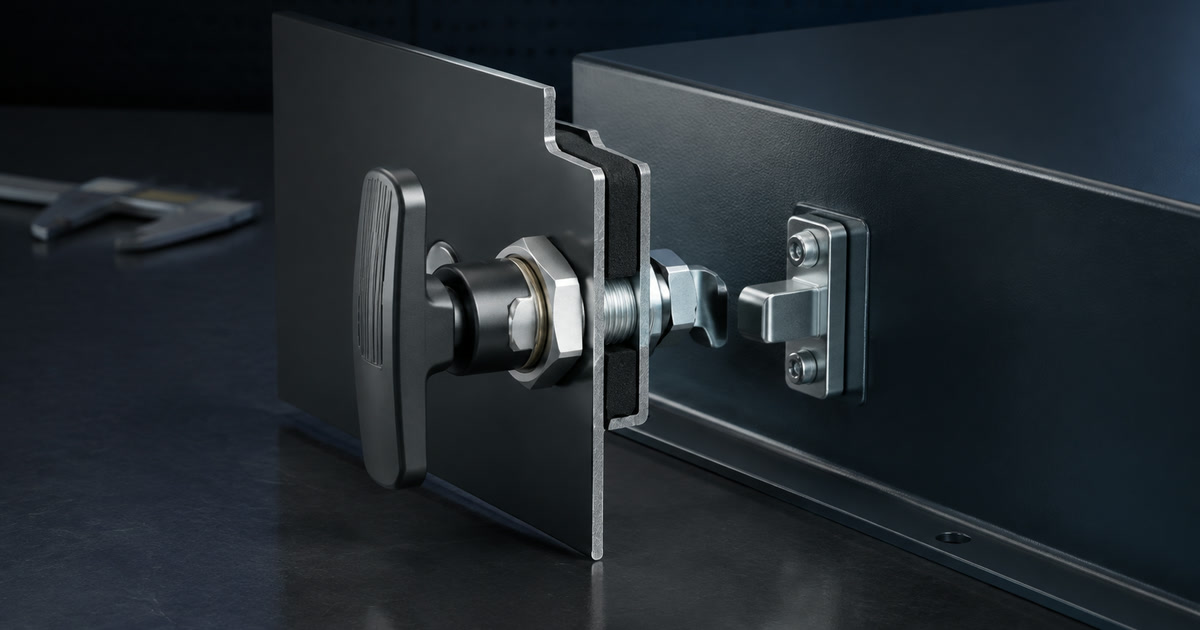
Generic industrial compression latch shown beside a gasketed sheet-metal enclosure cross-section on a dark engineering workbench
Editorial illustration of compression-latch selection inputs. It is not a supplier model or statement of availability.

Direct answer

What is a compression latch, and when should a buyer use one?

A compression latch engages the frame and then applies controlled axial pull-up, pressing the door against a gasket or stop. Choose this family when compression stroke, gasket deflection and vibration control are design inputs—not merely when a rotating cam must hold a panel closed. Confirm grip and stroke from the exact installed section.

  • Separate the closed grip dimension from the available compression stroke.
  • Define the gasket condition and acceptable deflection before requesting a latch.
  • Ask what exact installed configuration supports any enclosure-rating claim.

Evidence at a glance

What Compression-Latch Data Does and Does Not Prove

Can a compression latch make an enclosure IP66 or Type 4?

Only evidence for the exact latch, gasket, cutout, mounting arrangement and completed enclosure can support that result; a component-family description cannot transfer the rating by itself.

Boundary: IEC defines the IP Code and UL explains enclosure-accessory evaluation, but neither source approves an unspecified buyer assembly.

Buyer action: Name the exact claim and request the report, certification scope and installed details that connect the candidate to it.

Is more gasket compression always better?

No. Excessive deflection can raise operating effort, distort a thin door and accelerate gasket compression set, so the acceptable window should come from the seal and enclosure design.

Boundary: A latch’s available stroke does not define the gasket manufacturer’s allowable deflection or the completed door’s stiffness.

Buyer action: Provide the gasket section and recommended compression window, then verify the closed stack-up on the actual assembly.

Primary sources:

Does a published latch load validate vibration service?

Not automatically. A static working or ultimate load does not establish fatigue life, pry resistance or response to the buyer’s shock and vibration spectrum.

Boundary: Published values remain tied to the exact model, load direction, mounting and test conditions stated by the manufacturer.

Buyer action: State the real load case and request exact-part data plus an installed validation plan proportionate to failure risk.

Primary sources:

Option comparison

Fixed-grip vs adjustable-grip compression latch: which should I specify?

Use fixed grip when the closed stack-up is controlled and matches an exact candidate; use adjustable grip when a defined range must absorb production variation or service change. Adjustment is not a substitute for documenting the nominal interface and tolerance.

Fixed-grip vs adjustable-grip compression latch: which should I specify?
Decision factorFixed gripAdjustable grip
Best fitStable, controlled door-and-frame stack.Defined variation across assembly or service conditions.
RFQ inputNominal grip, tolerance and required stroke.Nominal grip, full range, locking and setting method.
Assembly controlPart fit depends directly on stack-up control.Setting must be controlled and protected from drift.
Common mistakeTreating panel thickness as complete grip.Using adjustment to hide an undefined interface.
Decision basis: TW RFQ comparison based on the cited compression-latch families. Exact adjustment range, retention, load and sealing statements remain candidate-specific.

Configurations to compare

Fixed-Grip Cam-and-Pawl

Fits a controlled closed stack-up where the candidate drawing’s grip and pull-up travel match the door, gasket and frame.

Adjustable-Grip Threaded

Adds field or assembly adjustment for tolerance, gasket set or several closely related panel stacks.

Hand-Operated

Uses a wing, knob or T-handle when tool-free access is acceptable and the operating envelope is clear.

Tool- or Key-Operated

Restricts casual access or supports a service-tool policy; access style is separate from sealing and security evidence.

Flush or Recessed Lever

Reduces projection but introduces cutout, internal-clearance, pinch and lever-sweep requirements.

Selection factors

Grip, Stroke and Gasket Inputs for a Compression Latch Quote

Compression Latches RFQ selection factors
FactorWhat to specify
Closed gripDimension the installed distance using the candidate drawing’s reference surfaces with the door latched and gasket in its defined condition.
Compression strokeState required axial pull-up travel separately from grip range and give the acceptable gasket deflection or load window.
Door and frame interfaceProvide thicknesses, cutout, bends, offsets, keeper or cam engagement, closed gap and rear clearance.
Load and dutyState working load direction, shock, vibration, target cycles, operating effort and the responsible safety factor.
Access and rotationDefine hand, tool, key or padlock operation, viewed-side rotation and any keyed-alike requirement.
Material and environmentDescribe housing, cam and fastener materials plus corrosion, temperature, UV, washdown and chemical exposure.
Required evidenceName the desired IP or enclosure Type result, exact installed subject and report or certification scope to review.

Installed interface

  1. 01

    Operator input

    Handle, tool or key style, rotation, operating effort and available sweep.

  2. 02

    Housing and cutout

    Panel thickness, hole form, anti-rotation detail, seals and rear installation space.

  3. 03

    Compression mechanism

    Grip reference, pull-up stroke, adjustment, cam geometry and retention.

  4. 04

    Door, gasket and frame

    Closed gap, gasket condition, stiffness, keeper surface and tolerance stack.

  5. 05

    Completed enclosure

    Environmental claim, installation instructions, test subject and evidence scope.

Practical answer

How should I measure compression-latch grip for an RFQ?

Measure between the exact door-side and frame-side reference surfaces used on the candidate drawing, with the door fully closed and the gasket at its defined compression. Show bends, offsets, keeper or cam engagement and the closed gap, then state nominal grip, tolerance stack, pull-up travel and required adjustment as separate values.

  1. Draw one closed cross-section through latch and frame.
  2. Identify the candidate drawing’s grip reference surfaces.
  3. Add panel thicknesses, bends, offsets, gap and gasket condition.
  4. State nominal grip and worst-case tolerance separately.
  5. Record compression stroke and adjustment range as distinct requirements.
Reference basis:

Copy into your request

Compression Latches RFQ template

Closed door-and-frame section with reference surfaces: [ ]
Nominal grip, tolerance stack and adjustment range: [ ]
Required pull-up travel and gasket deflection window: [ ]
Cutout, anti-rotation detail, cam or keeper geometry and rear clearance: [ ]
Actuation style, closing direction and access policy: [ ]
Working load, shock, vibration, cycle target and operating effort: [ ]
Material, finish, seal and environmental exposure: [ ]
Exact enclosure claim and supporting-evidence request: [ ]
Prototype, order and annual quantities: [ ]

Application decision

Matching a Compression Latch to Gasket, Access and Rating Needs

Matching a Compression Latch to Gasket, Access and Rating Needs
Application conditionRFQ direction
Controlled gasket compressionEvaluate compression action and define gasket condition, pull-up stroke and the closed stack-up.
Large stack-up variationConsider adjustable grip only with a defined range, setting method and retention requirement.
Frequent tool-free accessCompare hand-operated forms against projection, snag, operating effort and access policy.
Restricted service accessSpecify tool or key code, keying policy and rotation without treating it as certified security.
Enclosure-rating objectiveRequest evidence for the exact installed configuration rather than a transferable component claim.

Applications to describe in the RFQ

01

Outdoor Electrical Cabinets

Describe weather exposure, gasket system, door stiffness, cutout and the exact enclosure evidence required.

02

Mobile Equipment Compartments

Add shock, vibration, slam conditions, service frequency and protection against unintended opening.

03

HVAC and Filtration Doors

State pressure direction, filter or gasket condition, access interval and allowable operating effort.

04

Washdown Machinery

Identify cleaning chemicals, temperature, spray direction, drainage and completed-assembly validation.

Buyer questions

Compression Latches FAQ

Answers without a listed source are TW RFQ editorial guidance, not an external standard or part-specific approval.

What does compression stroke mean?

It is the axial travel used to draw the door toward the frame after engagement; it is not the same as the total grip range.

Compression latch or quarter-turn cam latch: which should I use?

Use a compression latch when the door must be pulled against a gasket with controlled travel; a quarter-turn cam latch holds a panel closed without that pull-up. The compression latch vs quarter-turn cam latch comparison sets out the differences.

Can a compression latch be key- or padlock-operated?

Yes. Compression latches are made with wing, T-handle, tool-insert and key-cylinder operators, and some handles accept a padlock. State the operator, the closing rotation seen from a defined side and any keyed-alike requirement; a key or padlock restricts casual access but is not certified security on its own.

Can I select a compression latch from a photo?

No. A photo can show the operating style, but it does not establish grip, stroke, cutout, cam geometry, rear clearance or evidence scope.

Technical reference basis

Sources

What these buyer guides do not establish

Sources last checked: .

Private sourcing review

Have a drawing, photo or reference part?

Send the interface and commercial requirements for a focused Taiwan sourcing review.

Request a Quote