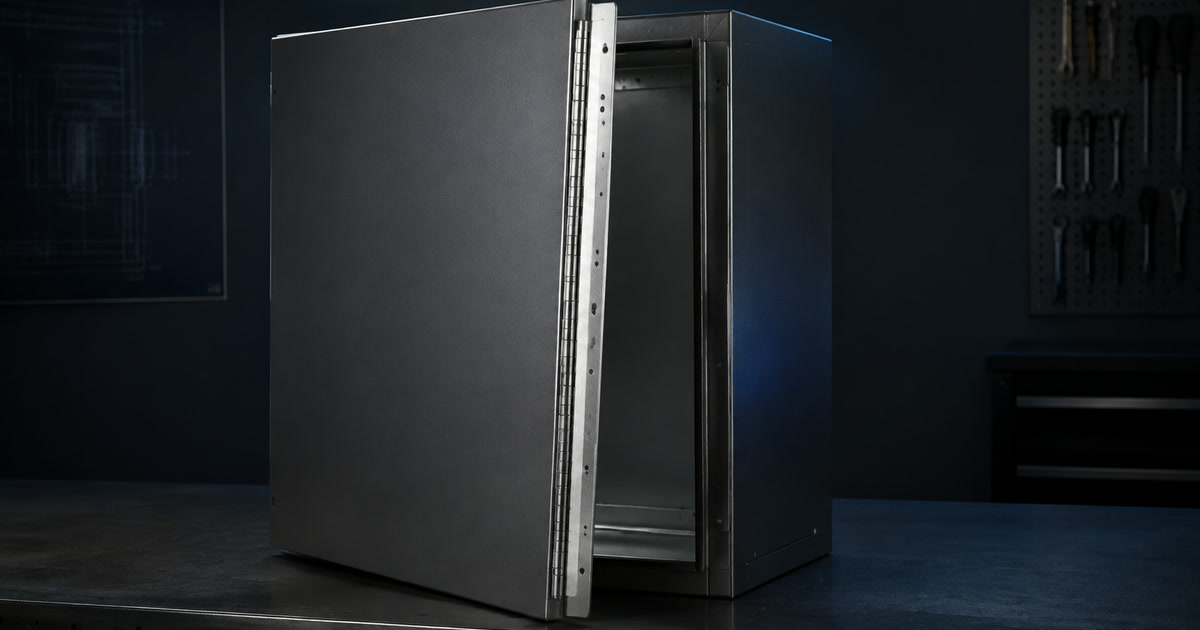
Full-length hinge-line support

Continuous and Piano Hinges for Industrial Enclosures

A continuous hinge, often called a piano hinge, runs the full length of a door or lid. It can distribute attachment and align a tall panel, but you still need to specify door moment, fastener spacing, leaf geometry, pin retention and corrosion exposure.

By · ·

Generic full-length stainless piano hinge installed along a tall industrial cabinet door edge
Editorial illustration of a continuous hinge and long door interface; not a supplier-specific profile.

Direct answer

What is a continuous hinge, and when is it preferable to separate hinges?

A continuous, or piano, hinge extends along most or all of a door edge and distributes attachment over a long hinge line. It can improve alignment on long panels, but performance still depends on leaf and pin geometry, fastener spacing, door moment, mounting material, manufacturing quality and the installed environment.

  • Specify finished length and all cross-section dimensions together.
  • Control drilling, end treatment and pin retention after cutting.
  • Validate the complete door moment and mounting structure rather than assuming full-length capacity.
Sources for this answer:

Evidence at a glance

Continuous Hinge Questions About Capacity, Modification and Corrosion

Does full-length support prove adequate door capacity?

No. A long hinge distributes attachment, but fastener pull-out, thin-sheet deformation, door moment, pin wear, alignment and fatigue can still govern.

Boundary: Catalog geometry or a material description cannot validate an unspecified door and mounting structure.

Buyer action: Submit the complete door load case and require candidate-specific attachment and life review.

Primary sources:

Can a piano hinge be cut or drilled without further controls?

Cutting and drilling can leave burrs, disturb pin retention, distort the hinge or remove corrosion protection, so the finished process needs its own requirements.

Boundary: Whether a specific stock length may be altered and how ends are retained remain supplier- and model-specific.

Buyer action: Specify finished length, holes, deburring, pin retention, finish restoration and final inspection in the RFQ.

Primary sources:

Can the leaves and pin be different materials?

They can, but dissimilar metals in contact along the knuckle can corrode galvanically when moisture bridges them, and a coated leaf running on a bare pin can wear through its finish. Treat leaf, pin and fastener materials as one pairing and check it against the real exposure; see material, finish and corrosion requirements.

Boundary: Galvanic behaviour depends on the metal combination, electrolyte, relative surface areas and finish, so a material name alone does not predict it.

Buyer action: State leaf, pin and fastener materials and finishes together, describe the actual exposure and ask the supplier to confirm the pairing for that environment.

Primary sources:

Option comparison

Pre-drilled vs undrilled continuous hinge: which is better for production?

Pre-drilled leaves make the hole pattern a controlled purchased feature; undrilled leaves give the enclosure fabricator flexibility. The better choice depends on who owns alignment, hole quality, finish restoration and inspection.

Pre-drilled vs undrilled continuous hinge: which is better for production?
Decision factorPre-drilledUndrilled
Pattern ownershipHinge supplier controls hole geometry.Enclosure fabricator controls hole geometry.
Assembly alignmentRepeatable if mating pattern is controlled.Flexible but sensitive to downstream fixtures.
Finish riskPurchased-hole edges can be included in finishing.Drilling may expose or damage finished surfaces.
RFQ inputHole pitch, diameter, countersink and tolerance.Drilling responsibility, fixture, deburr and inspection.
Decision basis: TW RFQ manufacturing-responsibility comparison supported by cited continuous-hinge technical material. Exact processing limits remain supplier-specific.

Configurations to compare

Undrilled Flat Leaf

Lets the fabricator own the hole pattern but requires explicit responsibility for alignment, spacing and post-processing.

Pre-Drilled or Countersunk

Controls production alignment when hole size, pitch, edge distance and countersink are specified.

Cranked or Offset Leaf

Fits displaced door/frame planes and adds bend direction, offset and installed-opening checks.

Double-Knuckle or Seal Carrier

Supports a special motion or sealing interface that must be defined by section, not by name alone.

Polymer Roll Hinge

Can suit selected environments and loads only after material, temperature, fatigue and attachment are validated.

Selection factors

Length, Leaf and Pin Inputs for a Continuous Hinge Quote

Continuous Hinges RFQ selection factors
FactorWhat to specify
Finished lengthState door length, exact hinge length, end clearance, cut tolerance and required end condition.
Leaf and pin sectionDimension open width, each leaf width, thickness, pin diameter, knuckle diameter and pitch.
Door loadProvide mass, centre of gravity, orientation, shock, cycles and attachment spacing for complete-door review.
Opening geometryState minimum angle, leaf offset or crank and the full door/frame interference envelope.
Hole and mounting patternControl hole type, pitch, edge distance, countersink, fastener or weld/rivet process and reinforcement.
Material pairingSpecify leaf and pin material, finish, galvanic neighbours, temperature and corrosion exposure.
Retention and maintenanceDefine removable or retained pin, cut-end treatment, lubrication and inspection access.

Installed interface

  1. 01

    Door leaf

    Width, thickness, holes, edge distance and attachment to the door.

  2. 02

    Frame leaf

    Width, offset, holes and attachment to the frame.

  3. 03

    Knuckle and pin

    Diameter, pitch, clearance, retention, material, wear and lubrication.

  4. 04

    Finished ends

    Cut tolerance, burr, pin capture and restored protection.

  5. 05

    Complete hinge line

    Door moment, straightness, fastener spacing, alignment, shock and cycles.

Practical answer

How are piano hinge sizes specified?

Piano hinge sizes are given as a finished length plus a cross-section, so control the two separately. For the section, state open width, individual leaf widths, leaf thickness, pin diameter, knuckle outside diameter and knuckle pitch, plus any crank or offset. Then define holes, end treatment and pin retention because two hinges with the same open width can still fit and behave differently.

  1. State finished overall length and cut tolerance.
  2. Dimension open width and each leaf width.
  3. Add leaf thickness, pin and knuckle diameters.
  4. Define knuckle pitch, gaps and any offset.
  5. Control holes, ends, pin retention and finish.
Reference basis:

Copy into your request

Continuous Hinges RFQ template

Finished length and end clearances: [ ]
Open width, leaf widths and thickness: [ ]
Pin diameter, knuckle diameter and pitch: [ ]
Flat, single-crank or double-crank section: [ ]
Hole pattern, countersink and fastener or weld method: [ ]
Door mass, centre of gravity, shock and cycles: [ ]
Opening angle and interference envelope: [ ]
Leaf/pin material, finish and galvanic environment: [ ]
Pin removal, retention, lubrication and cut-end treatment: [ ]

Application decision

Continuous Hinge Options by Hole Layout, Door Plane and Exposure

Continuous Hinge Options by Hole Layout, Door Plane and Exposure
Application conditionRFQ direction
Controlled production holesRequest a pre-drilled pattern with tolerances, countersinks and mating alignment defined.
Fabricator-owned hole layoutUse undrilled material with explicit drilling, deburr and finish responsibilities.
Displaced door planesDefine a cranked section and validate the installed sweep.
Corrosive serviceSpecify both leaf and pin materials, neighbouring metals and real exposure.
Long or heavy doorReview moment, panel stiffness, attachment spacing and fatigue as a complete system.

Applications to describe in the RFQ

01

Tall Control-Cabinet Doors

Use the long hinge line only after door moment, panel stiffness and fastener pull-out are checked.

02

HVAC Access Panels

Define gasket relationship, corrosion, pressure direction and service frequency.

03

Equipment Cases and Lids

Add shock, end retention, snag, opening stop and carrying environment.

04

Vehicle Access Doors

Include vibration, road spray, galvanic pairings and long-term pin wear.

Buyer questions

Continuous Hinges FAQ

Answers without a listed source are TW RFQ editorial guidance, not an external standard or part-specific approval.

When is a continuous hinge preferable to several butt hinges?

Use it when distributed attachment or long-panel alignment matters more than independent hinge replacement.

Is a continuous hinge the same as a piano hinge?

Usually, yes: "piano hinge" is the common name for a continuous hinge that runs the length of a door or lid. Industrial versions may add thicker leaves, larger pins, offset leaves or a seal carrier, so specify the leaf, knuckle and pin section rather than the name.

Should I request drilled or undrilled leaves?

Choose drilled leaves for a controlled production pattern; use undrilled leaves only when responsibility for locating and processing holes is clear.

How should I choose the hinge material?

Assess real atmosphere, chlorides, chemicals, galvanic neighbours, temperature, strength, finish and maintenance—not material name alone.

Technical reference basis

Sources

What these buyer guides do not establish

Sources last checked: .

Private sourcing review

Have a drawing, photo or reference part?

Send the interface and commercial requirements for a focused Taiwan sourcing review.

Request a Quote