Quick-access single-point closure

Quarter-Turn Cam Latches for Cabinets and Panels

A quarter-turn cam latch rotates a cam about 90 degrees to engage the frame, but that motion does not define fit. Buyers still need the installed grip, cam engagement, closing direction, panel cutout and access policy to compare candidates.

By · ·

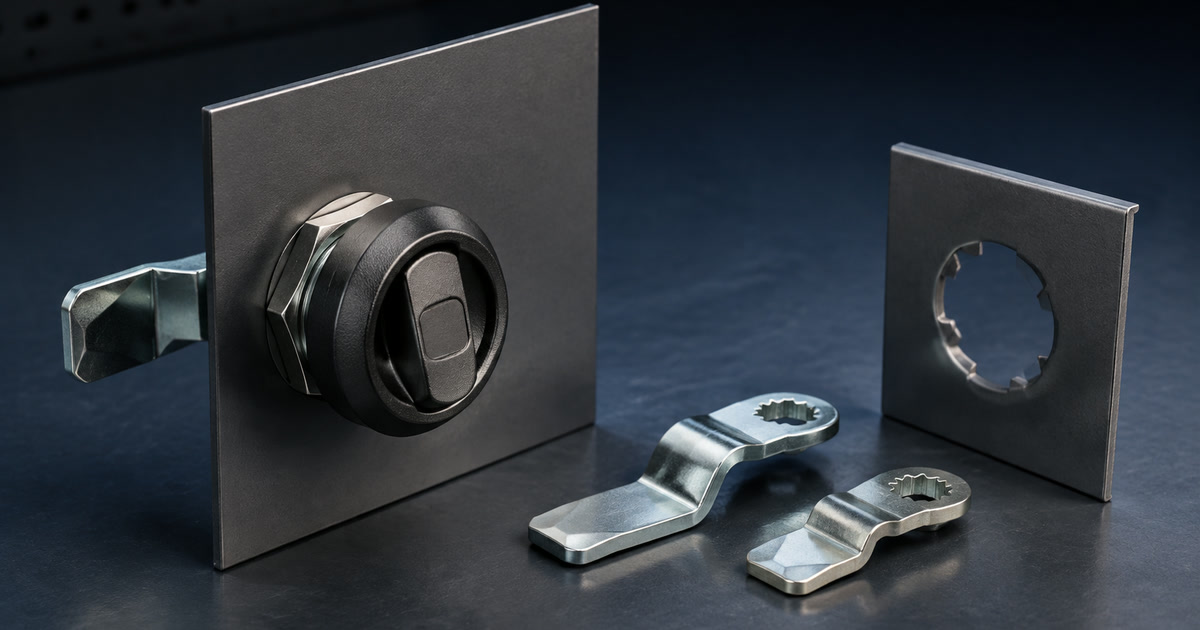
Generic quarter-turn cam latch with straight and offset cams arranged beside a sheet-metal cabinet panel section
Editorial illustration of cam-latch geometry, not a catalog offer or exact supplier design.

Direct answer

How does a quarter-turn cam latch work, and what should an RFQ specify?

A quarter-turn cam latch rotates a cam approximately 90 degrees behind a frame or keeper to secure a door. It is compact and quick to operate, but the buyer must define grip, cam geometry, rotation and access style. A ramped cam may snug the panel without providing the controlled pull-up of a dedicated compression latch.

  • Dimension closed grip from the candidate drawing’s references.
  • Show cam length, offset direction and keeper engagement in section.
  • Specify rotation and access method from a named viewing side.

Evidence at a glance

Quarter-Turn Latch Claims That Need Exact-Part Evidence

Does “quarter-turn” establish sealing or load performance?

No. Quarter-turn describes the operating motion; it does not by itself establish sealing, vibration resistance, security, working load or cycle life.

Boundary: Exact performance statements remain tied to a candidate model, mounting geometry, test method and completed-enclosure configuration.

Buyer action: Request exact-part drawings and data, then define the assembly-level evidence needed for the intended claim. If the part holds a removable panel rather than a hinged door, compare a stud-and-receptacle quarter-turn fastener instead.

Can I reverse an offset cam without changing fit?

Not safely by assumption. Reversing or rotating an offset cam can change grip, reach, closing direction and engagement with the frame surface.

Boundary: Type A, Type B and offset conventions can differ, so only the exact supplier drawing controls orientation.

Buyer action: Submit a closed cross-section and viewed-side rotation sketch, then obtain an approved installation drawing.

Primary sources:

Is a key-locking cam latch a high-security lock?

Not necessarily. A keyed insert can restrict casual access, but that feature alone does not prove forced-entry resistance or a security certification.

Boundary: Security depends on the exact lock, key system, cam, fasteners, door, frame and applicable test claim.

Buyer action: State the threat and required standard explicitly instead of substituting a generic keyed-access request, and name the insert profile or keyed cylinder the latch must accept.

Primary sources:

Option comparison

Straight cam vs offset cam: what changes in the RFQ?

A straight cam reaches a frame surface close to its own plane; an offset cam reaches a displaced surface. Both need the same controlled grip definition, but an offset adds direction, magnitude and rotation-envelope questions that a front view cannot resolve.

Straight cam vs offset cam: what changes in the RFQ?
Decision factorStraight camOffset cam
Frame relationshipEngagement surface is near the cam plane.Engagement surface is displaced from the cam plane.
Extra RFQ inputLength, thickness and overlap.Length, offset magnitude, offset direction and overlap.
Rotation riskCheck clear sweep and frame contact.Check sweep plus offset reversal and handed orientation.
Common mistakeUsing panel thickness as grip.Flipping the cam and assuming unchanged grip.
Decision basis: TW RFQ comparison based on manufacturer cam-latch geometry. Exact grip definitions, cam codes and handed conventions remain candidate-specific.

Configurations to compare

Fixed-Grip Straight Cam

A compact choice when the mounting plane and frame engagement match a controlled, direct reach.

Fixed-Grip Offset Cam

Uses a cranked cam to reach a displaced frame surface; offset direction and viewed orientation matter.

Adjustable-Grip Cam

Provides a defined threaded range where stack-up variation cannot be handled by one fixed geometry.

Hand-Operated

Wing, knob, T- or L-handle actuation supports frequent access but changes projection and operating clearance.

Tool- or Key-Operated

Supports a service-access policy or casual access restriction without implying high-security certification.

Selection factors

Grip, Cutout and Cam Inputs for a Quarter-Turn Latch Quote

Quarter-Turn Cam Latches RFQ selection factors
FactorWhat to specify
Closed gripMeasure the installed latch-reference-to-frame distance in the closed condition and state nominal plus tolerance.
Panel cutoutProvide door thickness, hole shape, anti-rotation flats or tab and required installation depth.
Cam geometryDimension length, offset magnitude and direction, thickness, rotation envelope and keeper overlap.
Rotation and handingState clockwise or counter-clockwise closing from a defined viewed side and include door handing.
Access methodChoose hand, tool or key operation and state any keyed-alike, master-key or key-removal policy.
EnvironmentDefine materials, finish, external seal, corrosion, temperature, UV and cleaning exposure.
Load and systemState working load, vibration, cycles and whether one point or a complete multi-point linkage is required.

Installed interface

  1. 01

    Actuator

    Hand, tool or key interface, viewed-side rotation and access policy.

  2. 02

    Housing and panel

    Cutout, anti-rotation, thickness, seal and installation depth.

  3. 03

    Cam

    Length, offset, thickness, orientation, retained fastener and sweep.

  4. 04

    Frame or keeper

    Closed grip, overlap, contact edge and tolerance stack.

  5. 05

    Closure system

    Single point or linked rods, guides and keepers plus the completed claim boundary.

Practical answer

How do I specify cam direction without ambiguity?

Create a viewed-side sketch that labels the outside and inside faces, hinge side, latch centre and the direction that closes the cam. Add the closed section showing cam offset and frame engagement. Do not rely on Type A, Type B, right-hand or left-hand language without linking it to the candidate supplier’s drawing convention.

  1. Name the viewing side.
  2. Mark outside, inside and hinge edge.
  3. Draw clockwise or counter-clockwise closing.
  4. Show the cam in closed section with its offset.
  5. Require the approved candidate drawing to repeat the convention.
Reference basis:

Copy into your request

Quarter-Turn Cam Latches RFQ template

Closed grip and tolerance: [ ]
Door thickness and complete cutout: [ ]
Cam length, offset, thickness and keeper overlap: [ ]
Closing direction with viewed-side sketch: [ ]
Hand, tool or key actuation and keying policy: [ ]
Working load, vibration and cycle target: [ ]
Materials, finish and external environment: [ ]
One-point or multi-point system boundary: [ ]
Prototype, order and annual volumes: [ ]

Application decision

Choosing a Quarter-Turn Latch by Frame Reach, Access and Closure Points

Choosing a Quarter-Turn Latch by Frame Reach, Access and Closure Points
Application conditionRFQ direction
Stable direct frame reachStart with a fixed-grip straight cam and verify closed grip plus overlap.
Displaced engagement planeUse an offset-cam review with magnitude, direction and sweep clearly drawn.
Variable stack-upEvaluate adjustable grip with a bounded range and a controlled setting method.
Frequent accessCompare hand operation with projection, glove use and unintended-actuation risk.
Several closure pointsDefine the rods, guides, travel, keepers and adjustment as one multi-point system.

Applications to describe in the RFQ

01

Control Cabinets

Include door return, cutout, grip, service tool and any completed-enclosure evidence target.

02

Server and Telecom Racks

Define access policy, panel thickness, grounding implications and frequent service duty.

03

Machine Access Panels

Separate convenience closure from any safety-related guard or interlock function.

04

HVAC Service Panels

State filter pressure, vibration, corrosion environment and whether several locking points are needed.

Buyer questions

Quarter-Turn Cam Latches FAQ

Answers without a listed source are TW RFQ editorial guidance, not an external standard or part-specific approval.

What panel cutout does a quarter-turn latch need?

The cutout comes from the exact latch body: send the door thickness, the hole shape with any anti-rotation flats or tab, and the installation depth behind the panel, then match them to the candidate drawing. Grip is a separate measurement, taken the same way as compression-latch grip.

What do Type A and Type B rotation mean?

They commonly identify opposite closing directions, but the viewed-side convention must be confirmed on the candidate drawing.

When is an offset cam needed?

Use one when a straight cam cannot reach the frame surface at the required grip, then define offset direction and rotation envelope.

Can one quarter-turn operate several points?

Some systems use rods or linkages, but travel, guides, keepers, loads and adjustment must be specified as one assembly, as with swing handles and multipoint rod locking.

Technical reference basis

Sources

What these buyer guides do not establish

Sources last checked: .

Private sourcing review

Have a drawing, photo or reference part?

Send the interface and commercial requirements for a focused Taiwan sourcing review.

Request a Quote