Material and exposure decision guide
Enclosure Hardware Materials, Finishes and Corrosion Requirements
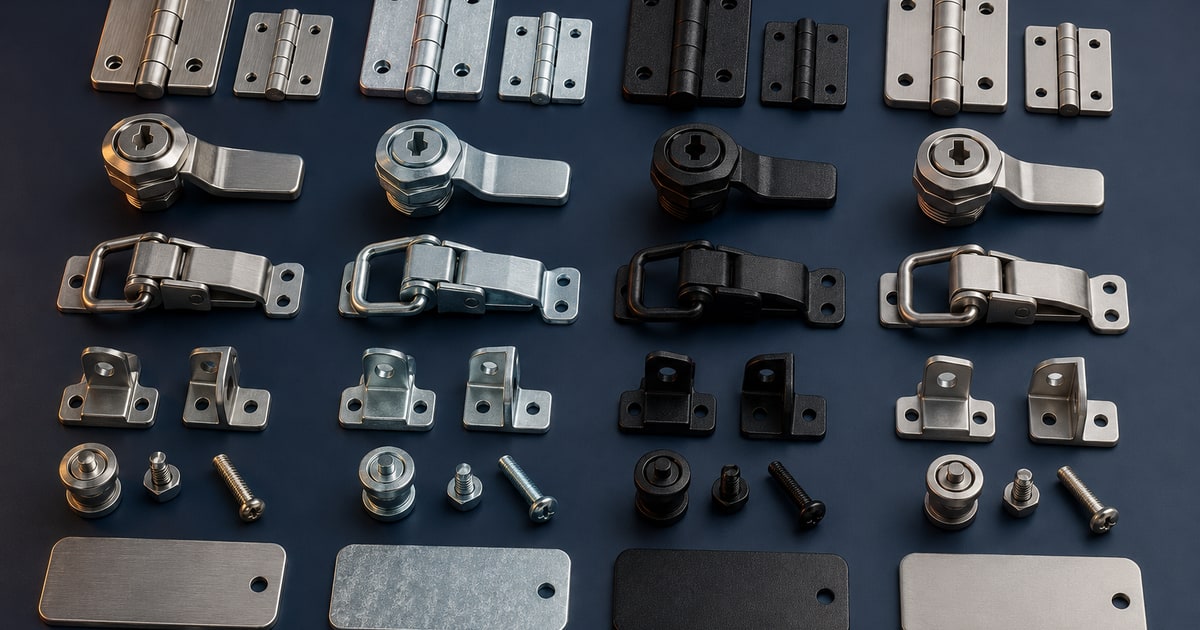
Enclosure hardware materials, finishes and corrosion requirements should follow the installed environment: translate it into a controlled base material, such as 304 or 316 stainless, a surface treatment and an evidence requirement before comparing parts or quotations.
Direct answer
How Should a Buyer Specify Material, Finish and Corrosion Resistance?
Choose enclosure-hardware materials and finishes from the installed exposure and the evidence the buyer will accept—not from a generic “corrosion-resistant” label. Define the base material, complete finish, mating metals, moisture, chloride or chemical exposure, cleaning and appearance limits. If accelerated corrosion testing is required, specify the method, finished test article and pass/fail criteria without equating chamber hours to outdoor life.
- Define the installed micro-environment before naming a material or coating.
- Write the base metal and complete surface-treatment system as separate controlled fields.
- Tie every test claim to a method, specimen, condition and acceptance criterion.
TW RFQ synthesized this buyer workflow from the cited corrosion-test, coating, passivation and enclosure-evaluation sources. Those sources define narrower methods and scopes; they do not select a material for a particular enclosure, predict service life or certify an unnamed component.
- ASTM B117 — Standard Practice for Operating Salt Spray (Fog) Apparatus — ASTM International
- ISO 9227:2022 + Amd 1:2024 — Corrosion Tests in Artificial Atmospheres — International Organization for Standardization
- ASTM A967/A967M-25 — Passivation Treatments for Stainless Steel Parts — ASTM International
- ISO 19598:2016 — Zinc and Zinc-Alloy Coatings on Iron or Steel — International Organization for Standardization
- Galvanic Corrosion — Association for Materials Protection and Performance
Decision boundary
- Use this page for
- Convert the installed exposure into comparable base-material, finish-system, mating-metal and corrosion-evidence fields for an enclosure-hardware RFQ.
- Decision output
- A controlled material-and-finish requirement that names exposure, the complete candidate system, the test article and method, and the acceptance record.
- Does not establish
- Outdoor service life, a universally superior material, part-specific corrosion performance, or an IP or NEMA classification for the completed enclosure.
Evidence at a glance
What Salt-Spray, IP and Galvanic Claims Do and Do Not Show
Do salt-spray test hours predict outdoor service life?
No. ASTM B117 and ISO 9227 define controlled accelerated test environments. A useful requirement names the method, test article, preparation, duration, evaluation and acceptance criteria instead of converting chamber hours into years outdoors.
Boundary: The methods do not select a coating, rank unlike material systems universally or certify performance in the buyer’s installed micro-environment.
Buyer action: Write the test method, finished test article, preparation, duration, evaluation points and pass/fail criteria into the RFQ without translating hours into field life.
- ASTM B117 — Standard Practice for Operating Salt Spray (Fog) Apparatus — ASTM International
- ISO 9227:2022 + Amd 1:2024 — Corrosion Tests in Artificial Atmospheres — International Organization for Standardization
Does an IP66 or NEMA Type claim prove corrosion resistance?
No. IEC 60529 IP codes address protection against access, solids and water, while NEMA enclosure Types use a different environmental classification. Corrosion requirements and completed-enclosure evidence remain separate questions.
Boundary: A component material, finish or catalog claim does not automatically transfer an enclosure classification to a different cabinet or installation.
Buyer action: Specify corrosion exposure and acceptance evidence separately from the exact completed-enclosure IP or NEMA evidence required for the installed configuration.
- IEC 60529 Ed. 2.2 — IP Code — International Electrotechnical Commission
- ANSI/NEMA EN 10250-2024 — Enclosures for Electrical Equipment — Environmental Considerations — National Electrical Manufacturers Association
- Environmental-Rated Accessories for Enclosures — UL Solutions
When must galvanic corrosion be considered in enclosure hardware?
Consider it when dissimilar metals are electrically connected and an electrolyte such as retained moisture can bridge them. Record both metals, exposed-area relationship, fasteners, conductive paths, wet retention and any isolation or drainage strategy.
Boundary: A generic material name or galvanic-series position alone does not determine the behavior of the exact fabricated and coated assembly.
Buyer action: Mark every metal-to-metal contact, fastener, wet-retention area and drainage path on the assembly, then define any required isolation or coating continuity.
- Galvanic Corrosion — Association for Materials Protection and Performance
Decision framework
Convert Exposure into a Verifiable Finish Requirement
Use these questions to define the requirement. The final material system still needs application-specific engineering and part-level evidence.
| Service condition or claim | What the RFQ must resolve |
|---|---|
| Dry, controlled indoor use | State humidity and condensation risk, cosmetic limits, base metal, exact coating designation and thickness or an approved candidate specification. |
| Outdoor weather and condensation | Define wet and dry exposure, temperature range, drainage, damaged-edge risk, fasteners and evidence for the finished part. |
| Coastal, chloride or washdown exposure | Identify the chloride source, frequency, wet retention and crevices; request an exact grade or coating proposal with supporting evidence. |
| Chemical or repeated cleaning exposure | Name chemicals, concentration when known, temperature, contact duration and cleaning frequency. |
| Mixed-metal assembly | Identify contacting metals, fasteners, conductive washers, electrolyte exposure, drainage and any isolation requirement. |
| NEMA Type or UL 50E claim | Request the exact part or file record where applicable and completed-enclosure evidence; a material claim alone does not establish the rating. |
Working matrix
Compare Candidate Material-and-Finish Systems
Use this matrix to expose variables and evidence gaps before approving a candidate. It does not rank these systems universally; the installed exposure and exact part still control the decision.
| Candidate system | Variables the buyer must define | Evidence to request | Open application risks |
|---|---|---|---|
| Plated carbon steel | Base grade, zinc or zinc-alloy designation, thickness, supplementary treatment and significant surfaces. | Coating specification, thickness result and defined corrosion-test report when required. | Cut edges, threads, coating damage, crevices, mating metals and retained function. |
| Stainless steel | Exact grade, fabrication route, weld condition, cleaning, passivation and appearance. | Material identity plus agreed process and verification records. | Chlorides, crevices, contamination, mixed-metal contact and strength after fabrication. |
| Painted or powder-coated metal | Substrate, pretreatment, coating chemistry, thickness, color, cure and masked areas. | Approved coating system, thickness or cure checks and part-level test evidence. | Edge coverage, chips, thread and fit changes, UV, chemicals and repair method. |
| Anodized aluminum | Alloy, temper, anodizing type, thickness, sealing, color and contact surfaces. | Material and process records plus appearance and corrosion evidence for the defined exposure. | Wear, electrical contact, color variation, alkaline cleaners and galvanic couples. |
| Engineered polymer | Resin grade, reinforcement, color, additives, operating temperature and chemical exposure. | Exact grade data and part-specific dimensional, load, aging or chemical evidence as needed. | Creep, UV, cleaners, flammability, moisture, dimensional stability and change control. |
Define the Exposure Before Naming the Material
A useful corrosion specification begins with the micro-environment at the installed hardware, not only the building location. Record indoor or outdoor use, condensation, standing water, airborne or direct chlorides, industrial pollutants, cleaning agents, temperature, abrasion and whether deposits can remain in crevices.
Identify the result that matters: appearance, absence of base-metal attack, retained latch operation or preservation of an enclosure seal. These are different acceptance questions and may require different evidence.
Specify the Complete Material-and-Finish System
“Steel, zinc plated,” “stainless,” or “black powder coated” can leave decisive variables open. Identify the base material and grade where controlled, coating or treatment standard, designation or minimum thickness, supplementary sealer or topcoat, significant surfaces and appearance limits.
Review thread fit, press-fit features, electrical bonding and masked areas after coating. ISO 19598 illustrates why a zinc or zinc-alloy coating specification needs more than a finish name.
On exposed hardware such as continuous hinges, pull handles, recessed handles and coated sheet-metal brackets, coating on threads, knuckles and mounting faces can change fit, so name those surfaces on the drawing.
- ISO 19598:2016 — Zinc and Zinc-Alloy Coatings on Iron or Steel — International Organization for Standardization
Salt-Spray Test Hours: What ASTM B117 and ISO 9227 Results Show
Name ASTM B117 or the applicable ISO 9227 method, test article, preparation, orientation, exposure period, evaluation interval and exact acceptance criteria. State whether the requirement applies before or after assembly, deformation or installation.
These methods define controlled accelerated environments but do not provide a universal conversion from chamber hours to years of service or a ranking rule for unlike materials.
- ASTM B117 — Standard Practice for Operating Salt Spray (Fog) Apparatus — ASTM International
- ISO 9227:2022 + Amd 1:2024 — Corrosion Tests in Artificial Atmospheres — International Organization for Standardization
Treat Stainless Processing and Galvanic Corrosion as Design Inputs
A stainless grade name does not describe fabrication contamination, weld condition, cleaning, passivation, crevices or contact with other metals. If passivation is required, cite an applicable process and verification requirement.
Galvanic corrosion can occur when dissimilar metals are electrically connected in the presence of an electrolyte. Identify the full metal couple, exposed area relationship, fasteners, conductive paths, moisture retention and any isolation, drainage or coating strategy instead of evaluating one material in isolation.
ASTM A967/A967M-25 covers several passivation treatments and confirmation tests; it does not choose a stainless grade or guarantee suitability for a buyer’s exposure.
- ASTM A967/A967M-25 — Passivation Treatments for Stainless Steel Parts — ASTM International
- Galvanic Corrosion — Association for Materials Protection and Performance
Keep Component Evidence Separate from Enclosure Evidence
Environmental enclosure classifications apply within defined systems and configurations. A stainless latch or coated hinge does not independently make every cabinet compliant.
Where an evaluated accessory record is required, request the exact company, file, model, installation conditions and completed-assembly verification needed by the end product.
- ANSI/NEMA EN 10250-2024 — Enclosures for Electrical Equipment — Environmental Considerations — National Electrical Manufacturers Association
- Environmental-Rated Accessories for Enclosures — UL Solutions
Working checklist
Material, Finish and Corrosion RFQ Checklist
- Installed location and indoor or outdoor exposure are stated.
- Temperature, humidity, condensation and time-wet conditions are described.
- Chlorides, pollutants, chemicals and cleaning regimen are identified.
- Base material, exact grade and material-document requirement are separate fields.
- Coating or passivation system, standard, designation and thickness are defined.
- Mating metals, fasteners, isolation, drainage and crevices are shown.
- Significant surfaces, masking, threads, fits and cosmetic limits are marked.
- Test method, test article, preparation and duration are explicit.
- Acceptance criteria identify corrosion type, appearance or retained function.
- Required evidence is tied to the exact part and revision.
Avoidable risk
Corrosion Specifications That Create False Confidence
Finish by color
A color does not define the base metal, coating system, conversion treatment or thickness.
Hours become years
Accelerated salt-spray hours are converted directly into an outdoor life claim.
Grade without processing
A stainless grade is named while fabrication contamination, cleaning, passivation and crevices remain open.
Component becomes enclosure
A part claim is extended to a completed enclosure without configuration-specific evidence.
Buyer questions
Buyer questions
304 vs 316 stainless steel: is 316 always right for outdoor enclosure hardware?
Not automatically. Grade 316 adds 2.0–3.0% molybdenum, which improves resistance to pitting and crevice corrosion in warm chloride environments such as marine or de-icing-salt exposure, yet it can still pit, crevice-corrode and stress-corrosion crack in hot chloride conditions above about 50 °C. Surface finish, crevices, cleaning and mating metals also decide the result, so specify the exposure and the whole material-and-finish system, not the grade alone.
Which is better for enclosure hardware: zinc-plated steel or stainless steel?
Neither is universally better. Compare the installed exposure, required strength, fabrication, mating metals, coating damage, cleaning, appearance, evidence and cost, then approve an exact grade-and-finish system.
Is 316 stainless steel always the correct choice for outdoor hardware?
No. Chlorides, chemicals, temperature, crevices, fabrication, strength, cleaning and mating metals still matter. Request an exact proposal and evidence tied to the installed exposure rather than a universal grade rule.
How should corrosion-test acceptance criteria be written in an RFQ?
Name the test method and edition, finished test article, preparation, duration, evaluation intervals, significant surfaces, permitted appearance or corrosion and the pass/fail record required. Keep any field-life expectation separate from the accelerated-test requirement.
What evidence should support a corrosion-resistant finish claim?
Request the exact base material and finish designation, coating thickness or treatment where applicable, finished-part test basis, test article and acceptance record. If enclosure protection is also required, ask for configuration-specific IP or NEMA evidence separately.
Can an RFQ specify a finish only by color or commercial name?
Usually not when corrosion or interchangeability matters. Add the base metal, controlled coating specification, thickness where applicable, significant surfaces, appearance limits and required evidence.
- 316: the first step upAustralian Stainless Steel Development Association
Industry association explanation of grade 316, its 2.0–3.0% molybdenum, its advantage over 304 in warm chloride environments and its limits in hot chlorides.
- ASTM B117 — Standard Practice for Operating Salt Spray (Fog) ApparatusASTM International
Official standard page for the controlled salt-spray environment and its interpretation limits.
- ISO 9227:2022 + Amd 1:2024 — Corrosion Tests in Artificial AtmospheresInternational Organization for Standardization
Official scope and amendment listing for neutral, acetic-acid and copper-accelerated salt-spray methods. State the buyer-required edition; the method does not predict field life.
- ASTM A967/A967M-25 — Passivation Treatments for Stainless Steel PartsASTM International
Official scope for multiple passivation treatments and confirmation tests; it does not select a material grade.
- ISO 19598:2016 — Zinc and Zinc-Alloy Coatings on Iron or SteelInternational Organization for Standardization
Official scope illustrating designation, thickness, test and purchaser-information requirements for the stated coating family.
- Galvanic CorrosionAssociation for Materials Protection and Performance
Technical overview of the dissimilar-metal and electrolyte conditions behind galvanic corrosion; application-specific design still requires engineering review.
- ANSI/NEMA EN 10250-2024 — Enclosures for Electrical Equipment — Environmental ConsiderationsNational Electrical Manufacturers Association
Current standard listing for NEMA enclosure Types and environmental considerations; it supersedes ANSI/NEMA 250-2020.
- Environmental-Rated Accessories for EnclosuresUL Solutions
Official overview of how exact enclosure accessories may be evaluated for defined environmental conditions.
- IEC 60529 Ed. 2.2 — IP CodeInternational Electrotechnical Commission
Official scope for enclosure protection against access, solids and water; it is not a corrosion-life system.